
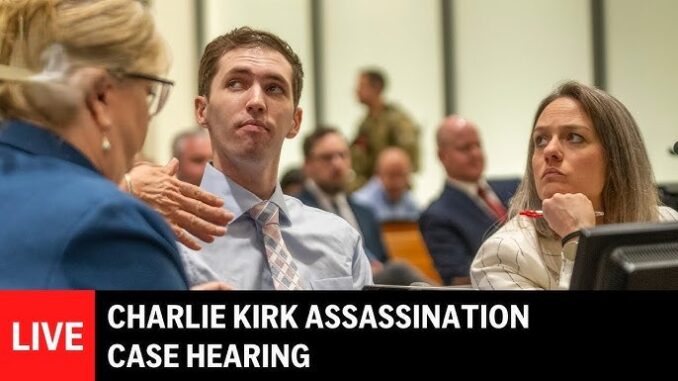

The preliminary hearing focused heavily on one core issue: how strong the evidence really is linking Tyler Robinson to the shooting death of Charlie Kirk. Much of the questioning centered on surveillance footage, the timing of the investigation, the recovery of a gun, and what investigators did and did not know before Robinson turned himself in.
For anyone trying to understand this case, the key takeaway is simple. The dispute is not only about whether investigators found evidence. It is also about how direct, visible, and reliable that evidence is.
Why the hearing focused so much on the gun and the video
A major point raised in court was whether the available footage clearly shows a firearm in the suspect’s hand. The agent’s testimony drew an important distinction between an observed object and a clearly identifiable gun.
According to the testimony, investigators believed the person seen leaving the roof area was carrying a long object that appeared concealed or bagged. Based on training and experience, the object could have been a firearm. But the footage itself did not plainly show an actual gun.
That distinction matters because criminal cases often depend on how much a recording proves on its own versus how much must be inferred from context.
What investigators said about the rooftop footage
The rooftop footage was another major flashpoint. Testimony indicated that, by itself, that video did not reveal enough detail to identify the person with certainty.
Points emphasized in court included:
No clear facial detail was visible from the rooftop footage alone.
Clothing details were limited, though there had been discussion about a possible shirt pattern seen during the jump from the roof.
The rooftop clip was not enough on its own to make a visual identification.
That limitation became central to the defense challenge. If the rooftop footage is indistinct, then prosecutors must rely more heavily on other evidence such as additional videos, screenshots, witness accounts, location data, and the eventual surrender.
How the person of interest was developed before Robinson surrendered
Investigators testified that before Robinson turned himself in, they had identified a person of interest but did not yet specifically know who the shooter was.
This is an important procedural point. It suggests the investigation had narrowed attention toward a possible suspect through collected evidence, but had not yet reached a firm identity linked by name.
The hearing also highlighted that images from another location, described as a stairwell in a parking garage, were released publicly. Those images appear to have played a larger role in building a lead than the rooftop footage by itself.
What the timeline testimony reveals
The questioning also dug into how the investigation timeline was created. The agent testified that he made his own timeline over the course of the investigation after extensive review of video and other materials.
That matters for two reasons:
It shows the timeline was investigative work product, built gradually rather than instantly assembled at the start.
It undercuts any assumption that investigators had a fully documented sequence early on, before the surrender.
In practical terms, this means the sequence of events was pieced together over time through review, comparison, and analysis of multiple sources.
How long the shooter appeared to be in position
Another notable detail involved the amount of time the person on the roof appeared to be prone before the shot.
The estimate given in court was roughly 15 to 30 seconds in the prone position, though it was also clarified that getting into position likely took longer. The distinction is important because it separates:
moving into place
establishing the position
firing
getting up and fleeing
That sort of timing can become relevant in later arguments about planning, opportunity, and what others at the event may or may not have noticed.
What other footage showed at the scene
The hearing showed that investigators had more than one video angle from the event area. That matters because a single camera rarely tells the whole story.
The testimony referenced footage that captured:
the area behind the tent at the time of the shot
a direct angle facing Charlie Kirk and parts of his security team
additional source footage from a media provider, including angles not shown in court that day
One specific point established was that, in the visible portion directly behind the middle of the tent, no one was standing there at the moment discussed, though a videographer could be seen to one side and anything outside the frame remained unknown.
This kind of detail can matter when lawyers test line-of-sight arguments, possible obstructions, and whether anyone else may have been in a position relevant to the shot.
The recovered gun and why it remains contested
The hearing title itself reflects one of the most debated issues: the recovered gun. Testimony indicated that footage review led investigators to identify an area in a wooded or forested location that might have evidentiary value. That area was secured, and a gun was later found there.
But the agent also testified to an important limitation: he was not personally involved in the search for the gun or in processing it afterward.
That leaves several evidence questions especially important:
Who specifically found the gun?
How was it documented and collected?
What chain of custody records exist?
What forensic testing was or was not done?
Those questions are common in serious felony cases. The existence of a recovered weapon can be significant, but the courtroom value depends on how clearly it can be linked to the alleged shooter and the shooting itself.
What the autopsy-related testimony added
The autopsy portion of the hearing was narrower, but still useful for understanding the evidence flow. The agent was not present for the autopsy and said his knowledge came from a meeting with the medical examiner and the report.
He also testified that the purpose of the meeting with the medical examiner was to gather information, not to provide investigative conclusions.
Additional items referenced as moving through evidence handling included:
autopsy photos
fingerprints on a CD
the report itself
bullet or projectile fragments collected as evidence
personal items intended for return to the family
For readers following the legal significance, this section points to the importance of medical evidence chain of custody alongside scene evidence chain of custody.
What the Ring camera testimony suggested
Another small but notable area involved a Ring camera video connected to a vehicle. Investigators said the purpose of interviewing the homeowner was to verify the authenticity of the recording.
When pressed about what was remembered from that report, testimony acknowledged details that had not been mentioned earlier, including:
a report that the driver appeared to be bald
a belief that three other people were in the vehicle
That exchange matters because it illustrates how defense attorneys often probe for omitted details that could affect interpretation of a video or challenge the completeness of an investigator’s summary.
What happened before Robinson turned himself in
One of the clearest factual points from the hearing was that Robinson voluntarily surrendered. Testimony placed that surrender on September 11, and indicated that no arrest team went out to capture him first.
The account presented in court was that:
someone helped facilitate the surrender through the sheriff’s office
the arrangement involved a person known to the family
Robinson went to the Washington County Sheriff’s Department voluntarily
that surrender was the first point at which investigators had his name connected to the case in a concrete way
That does not resolve guilt or innocence. But it is a legally relevant detail because surrender can affect how the defense frames intent, flight, cooperation, and state of mind.
How public tips shaped the early investigation
The hearing also made clear that investigators received a large volume of public tips before the surrender. These included possible suspect identifications and other information sent in by the public.
Much of that intake was handled through a state information and analysis center rather than solely by the lead investigators themselves.
This is typical in high-profile cases. Public tip systems can be useful, but they also create challenges:
many tips are inaccurate
some are duplicative
some introduce alternative suspect theories
investigators must separate useful leads from noise
Questions the defense appeared to be raising
Although the hearing did not decide the full case, the questioning revealed several defense themes that may continue to matter:
The surveillance footage does not clearly show a firearm.
The rooftop video alone does not identify the shooter.
Some investigative conclusions rely on interpretation rather than direct visual proof.
Not every investigator who testified personally handled every piece of physical evidence.
There were multiple videos and not all angles were shown in court during that exchange.
These are the kinds of issues defense attorneys often use to challenge probable cause, weaken confidence in narrative certainty, or preserve arguments for trial.
Questions prosecutors are likely to rely on
On the other side, prosecutors are likely to emphasize the broader evidentiary picture rather than any single frame of video.
Based on the hearing, those points may include:
video showing a person on the roof and then leaving
a long concealed object consistent with a firearm
investigative video review leading to an evidentiary search area
recovery of a gun in that area
publicly released images that helped focus the investigation
Robinson’s voluntary surrender and acceptance of responsibility being tied to his name
In many criminal cases, prosecutors do not need every individual piece of evidence to prove the case by itself. They aim to show how the pieces fit together.
Common misconception about surveillance evidence
A common misconception is that a case either has a perfect recording of the crime or has no meaningful video evidence at all. Real investigations are rarely that simple.
More often, video evidence works like this:
one clip shows location
another shows movement
another helps with timing
witnesses fill in context
physical evidence is used to connect the rest
That appears to be exactly why so much attention was given to timelines, camera angles, witness descriptions, the wooded search area, and the surrender sequence.
What this hearing does and does not prove
A preliminary hearing is not the same as a trial. It is generally used to test whether there is enough evidence to move the case forward, not to issue a final verdict.
So this hearing does not by itself answer every ultimate question about guilt. What it does show is where the strongest disputes are likely to be:
the clarity of the video evidence
the strength of the gun connection
the completeness of investigative handling and documentation
the significance of Robinson’s surrender
Bottom line
The most important development from this hearing is that the prosecution’s theory appears to rely on a combination of surveillance footage, investigative reconstruction, recovered physical evidence, and Robinson’s surrender, while the defense is pressing the point that none of the most discussed video clips clearly shows a gun or clearly identifies the shooter on its own.
That is the tension at the center of the case. The legal fight is not just about what was found, but about how confidently each piece can be connected.
For general background on how preliminary hearings work in criminal cases, the Legal Information Institute offers a useful overview. For broader information on digital evidence handling and chain of custody, guidance from the National Institute of Justice can also be helpful.
This article was inspired by a video from Law&Crime Trials.
Adapted for readers by #teamHJB of ReelToRead.com — turning great videos into even better reads.

Be the first to comment