


How a small island shapes big ideas
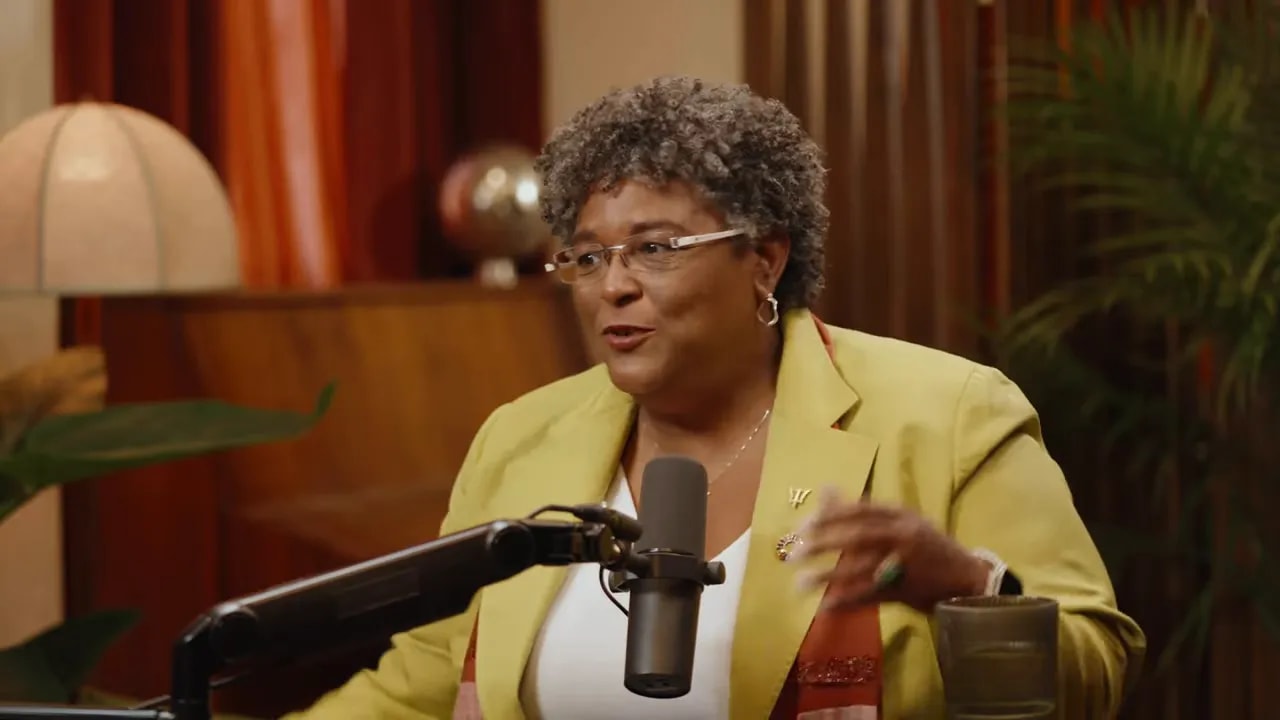
Mia Mottley, Prime Minister of Barbados, turns conversations about island culture into sharp lessons on global fairness, finance, and climate. In a long, candid conversation with Trevor Noah, she traces the line from local phrases and sports to international institutions, arguing that the world’s rules still reflect an imperial era and that fairness requires intentional rethinking.

Rihanna, “dying fair,” and the idea of inclusion
Mottley starts with a simple observation: you cannot tell Rihanna’s story without talking about Barbados. That connection is more than celebrity origin story. It is a cultural root that explains why Rihanna’s companies prioritized inclusion — makeup shades for all skin tones and lingerie for all body types — and why that approach has global resonance.
“You can’t unfair that body. That ain’t fair.” — Mia Mottley
That Barbadian sense of social justice — captured by the colloquial phrase Mottley repeats as “dying fair” — becomes a throughline for the rest of the discussion. Inclusion, she argues, is not a marketing ploy. For small nations, it is survival and dignity.
History, dignity, and the duty to “pay forward”
Barbados’s modern story is shaped by conquest and exploitation. Mottley revisits the island’s 17th-century laws and the 1661 slave code that helped formalize institutional racism across the Americas. That grim history fuels a contemporary ethic: Barbados has a responsibility to promote dignity and fairness on the global stage.
Mottley uses the island’s past to explain why Barbadians expect fairness in global systems. When powerful states craft rules without proportionality, small states bear disproportionate costs. She frames this as a matter of principle rather than grievance.
Population puzzles: family planning, decline, and the skills gap
Barbados now counts fewer than 300,000 people. Strong family planning, emigration, and changing life choices have led to a demographic squeeze. Schools are seeing fewer new students each year. For a leader, declining population is not merely abstract: it means a shrinking labor pool and looming shortages of essential skills.
Mottley describes creating a national population commission to confront the issue head-on. The reality is complex. Decline can be the product of social progress — more choice, higher living standards — but it still creates immediate policy problems: pensions, healthcare, workforce replacement, and economic resilience.
Migration: moving people the way we move money
One of Mottley’s sharpest critiques is this: globally, we know how to move capital but not how to move people with dignity. Migration debates, she argues, are often rooted in fear and racism rather than pragmatic planning. The result is tragedy: avoidable deaths at sea, wasted potential, and labor mismatches.
Mottley advocates for structured, mutually beneficial migration frameworks — think seasonal labor programs scaled and modernized. Technology makes this feasible; politics and empathy are the barriers.
Road tennis and practical creativity
Small details reveal big imagination. Road tennis — a Barbadian street sport played with plywood rackets, a low net, and a tape ball — becomes a metaphor. It is low-resource, community-driven, and adaptable. When leaders can re-imagine everyday life like this, simple innovations spread.
The browning of the world and the politics of fear
Mottley borrows the phrase “the browning of the world” to describe demographic and cultural blending that scares some populations. But she frames that fear alongside structural decline: when jobs disappear, people look for scapegoats. The remedy is not shutting borders; it is addressing inequality, rebuilding opportunity, and designing systems that let people thrive.
Small states, one-size-fits-all rules, and the Bridgetown Initiative
Small states often face rules crafted by much larger economies. Mottley challenges the logic behind how global institutions measure need — historic GDP per capita, rigid eligibility, and short loan tenors — and argues these tools ignore vulnerability.
The Bridgetown Initiative was born to change that. It bundles proposals to:
- Make global finance fairer by adjusting cost of capital for vulnerability and risk of climate wipeout.
- Increase transparency around credit rating and lending practices that penalize small states.
- Rebalance governance at institutions such as the IMF and World Bank so leadership reflects today’s global population and needs.

Methane as a climate “love language”
Climate action requires a common language that appeals to different incentives. Mottley offers a pragmatic lever: methane. Methane is far more powerful than carbon in the short term and comes from concrete, fixable sources — leaking pipelines, flaring, landfills, rice paddies, and livestock.
Fix the leaks, capture the gas, and the oil and gas companies can profit while the planet benefits. That framing — pairing environmental outcomes with business incentives — is the operational argument Mottley pushes: win-win policies that match the “love language” of private sector actors.

Debt, insurance, and making countries investable
Climate risk also shows up through insurance. As areas become uninsurable, they become uninvestable. Mottley describes how Barbados incorporated natural disaster clauses into commercial debt: legal triggers that free up funds when storms hit, allowing repair without immediate default.
She reframes debt sustainability as a long-term, humane exercise. A lost generation cannot be rebuilt by balance-sheet gymnastics. Longer tenors and cheaper capital are investments in people, not giveaways.
Local finance solutions: the “susu” and grassroots resilience

Collective savings practices — known across many cultures as “susu” or meeting turns — show how communities create credit where formal systems exclude them. Mottley highlights these informal networks as proof that risk is often overstated: poorer borrowers pay back reliably when given opportunity.
Technology and local financial innovation like mobile banking have scaled these ideas. The lesson is clear: when systems include rather than exclude, resilience grows from the ground up.
Examples of autonomy: Ethiopia’s dam and citizens’ financing
When international financing proved unavailable, Ethiopia turned inward — citizens bought bonds, banks supported projects, and the country completed a massive dam to power millions. Mottley presents that project as modern Adwa: local resolve that created renewable energy without waiting for permission.
What leaders can do differently
Mottley lays out practical shifts leaders should make:
- Reassess global governance so leadership reflects current global demographics and development needs.
- Price vulnerability, not just income when determining access to concessional finance and emergency support.
- Design migration deals that treat people with dignity and match labor supply with demand.
- Prioritize methane fixes as a fast, scalable climate intervention that aligns private incentives with planetary benefit.
- Promote long-tenor, lower-cost capital for human capital investments such as education and health.
Why hope matters — and how small voices change big rooms
Hope is central to Mottley’s worldview. She mixes faith with pragmatic timing: global crises, shifting circumstances, and moral persuasion can create windows where small nations shape outcomes. She borrows a Barbadian saying: “why not catch you and pass you” — reminding leaders that not-yet success is not the same as failure.
“If they don’t have a chair at the table for you, bring your folding chair.” — Mia Mottley
Communication, storytelling, and the role of culture
Mottley recognizes that technical proposals need champions. Artists, athletes, and storytellers can deliver messages in ways politicians cannot. That is why fairness campaigns must pair policy with narrative — a combination that changes minds and creates durable political will.
Practical takeaways
- Reframe climate action around near-term wins — methane reductions are fast, measurable, and profitable.
- Update financial rules so vulnerability, exposure, and wipeout risk factor into loan terms and ratings.
- Build structured migration frameworks that treat workers with dignity and enable circular flows of labor and capital.
- Empower local finance and scale community mechanisms with modern platforms.
- Use storytelling to make technical solutions politically viable.
Credit
Conversation recorded and hosted by Trevor Noah — channel https://www.youtube.com/channel/UC8bTQzxgvKkXDAaWkeuUlkg
Watch the full conversation
Adapted for readers by #teamHJB of ReelToRead.com — turning great videos into even better reads.


Be the first to comment