

A train runs through an apartment building. High-speed rail connects cities across an enormous country. Bridges stretch across mountain gorges, and skylines look like somebody built the future all at once.
I kept encountering images of modern China that made me ask the same question: How did they build all of this, so quickly?
My first explanation was pretty simple. China is a dictatorship. If the leader wants a bridge, the leader gets a bridge. No messy political fights. Just an order from the top, and construction begins.
But that explanation turns out to miss much of what actually happened. Behind China’s infrastructure boom is a much more interesting story about local governments, career ambitions, tax rules, land ownership, and the things powerful people get rewarded for doing.
It is also a story about extraordinary improvements in living standards, people forced out of their homes, and an economic model that could not keep producing the same results forever.
Key Takeaways
- China’s building boom depended on local incentives, not simply commands from a powerful national leader.
- Deng’s reforms rewarded officials for economic development and gave local governments financial reasons to pursue growth.
- Land financing made construction especially attractive, encouraging useful infrastructure alongside overbuilding and displacement.
- Slower growth and Xi’s changing priorities are reshaping the system behind China’s dramatic transformation.
Table of Contents
- Is China Communist or Capitalist? That Is Only Half the Question
- The Party Is Not Just in Charge of China. China Is Built Around It.
- Deng Xiaoping Changed What Officials Were Rewarded For
- “Separate Kitchens” Turned Local Governments Into Economic Players
- How Land Financing Made Building the Best Game in Town
- National Plans Met Local Ambition
- You Can Only Make That Economic Transformation Once
- Growth Was Only One Target. Stability Was the Other.
- The Coercion That a Skyline Does Not Show
- Xi’s China Is Moving Beyond the System That Built the Boom
- The Lesson Is About Incentives, Not Giving Up Rights
- Sources and Original Video
Is China Communist or Capitalist? That Is Only Half the Question
Before getting to the bridges, we need to understand the system that built them. And immediately, we run into a problem: China does not fit neatly into the economic categories many of us grew up with.
The simplified model goes something like this:
- A state-run economy: The government owns businesses and land and decides what gets produced.
- A market-driven economy: Businesses and property are mostly privately owned, and market demand shapes production.
Think of the Soviet Union on one side and the United States on the other. These are simplified descriptions, but they are the categories behind the familiar capitalism-versus-communism distinction.
China scrambles that distinction.
It has major state-owned businesses in industries such as oil, aviation, and telecommunications. It also has an enormous private sector, including companies such as Huawei and Alibaba.
The government has directed substantial support toward electric vehicles, batteries, solar technology, semiconductors, and artificial intelligence. But that does not mean every successful Chinese business emerged from a government plan. Large parts of the economy operate through markets and competition.
Land ownership adds another layer. Urban land is state-owned, while rural land is generally owned by village collectives. Individuals and developers can acquire rights to use that land, and buildings can be privately owned. You can own an apartment without owning the land beneath it.
For an ordinary person, much of daily economic life would feel familiar to an American: earning a salary, keeping money in a bank account, ordering from competing restaurants, buying a car, purchasing an apartment, or investing savings.
So is China communist and capitalist? Its economy contains features associated with both. But focusing only on the economy leaves out the institution that matters most: the Chinese Communist Party.
The Party Is Not Just in Charge of China. China Is Built Around It.
There is a useful clue on China’s flag. Its four small stars are traditionally associated with four social classes, and each is oriented toward the large star representing the Communist Party.
The symbolism points toward something fundamental. The party is not simply a political organization that happens to hold office, like Democrats or Republicans in the United States. It is woven into the country’s institutions.
About 7 percent of China’s population belongs to the party, roughly 100 million people. Membership itself is not a job. People join for different reasons: ideological commitment, public service, career opportunities, or some combination of those things.
From that enormous membership, the party recruits a much smaller group of professional officials. Smaller, in China’s case, still means millions of people.
These officials belong to a hierarchical organization that, in some ways, resembles a giant corporation. And understanding that hierarchy is essential to understanding how China works.
Two structures, but not two equal sources of power
China has recognizable levels of government: national institutions, provinces, cities, counties, and townships.
Alongside those government institutions sits a parallel party structure. A city has a government, but it also has a party committee. The same pattern continues up and down the system.
These structures are not equal. The party leads; the government handles much of the implementation.
A city mayor and a city party secretary might appear to occupy equivalent positions on an organizational chart. In practice, the party secretary is the more powerful figure, setting major priorities while the mayor administers them.

The overlap goes further: people holding powerful government jobs are generally party officials themselves. The party both directs the government and operates inside it.
At the top of the party, power narrows through increasingly exclusive groups:
- The Central Committee, with roughly 200 full members.
- The Politburo, with 24 members in the leadership structure examined here.
- The Politburo Standing Committee, with seven members.
- The general secretary, Xi Jinping.
Xi is also China’s president. But his position as general secretary of the Communist Party is more important to understanding his power than his presidential title.
This arrangement is called a party-state. Its roots are Leninist: a disciplined vanguard party leads the revolution and, after taking power, controls the state and its leadership appointments.
That is a much more useful answer to the question of what remains communist about China. It is not a Soviet-style command economy, nor has it achieved a classless communist society. But its governing machinery comes directly from the Marxist-Leninist tradition, and the party continues to identify communism as its ultimate goal.
Deng Xiaoping Changed What Officials Were Rewarded For
A party-state, by itself, does not explain China’s transformation. Other communist states did not produce the same economic results.
China’s reduction in extreme poverty was extraordinary, contributing enormously to the worldwide decline. The World Bank’s China overview provides additional context on that transformation. The question is what changed inside this political structure to help make it happen.
Start in 1976, when Mao Zedong died. China was poor, and its political and economic systems were in disarray. After a power struggle, Deng Xiaoping emerged as its paramount leader.
Deng was a committed party figure, but he was also a pragmatist. He understood poverty as a threat to the Communist Party’s survival. If the party wanted to keep ruling, it needed to improve people’s lives.
One of his most consequential changes sounds incredibly boring: he changed how officials were evaluated.
But imagine the scale of this organization. A national hierarchy branches into huge numbers of local governments, staffed by millions of officials. Many of those people want perfectly recognizable things: a promotion, a better salary, more responsibility, more power.
Change what earns a promotion, and you change the behavior of an enormous system.
From revolutionary credentials to economic results
Under Mao, revolutionary commitment, ideological fervor, and loyalty were central to advancement. Deng shifted the emphasis toward younger, better-educated, technically capable officials who could deliver practical results.
He also decentralized authority, giving local officials more room to experiment rather than concentrating every decision around a single leader.
The key assignment became economic development.
Officials were evaluated using detailed scorecards. Growth, tax revenue, and investment became important measures of success. If you wanted to climb the party hierarchy, improving your local economy was a powerful way to do it.
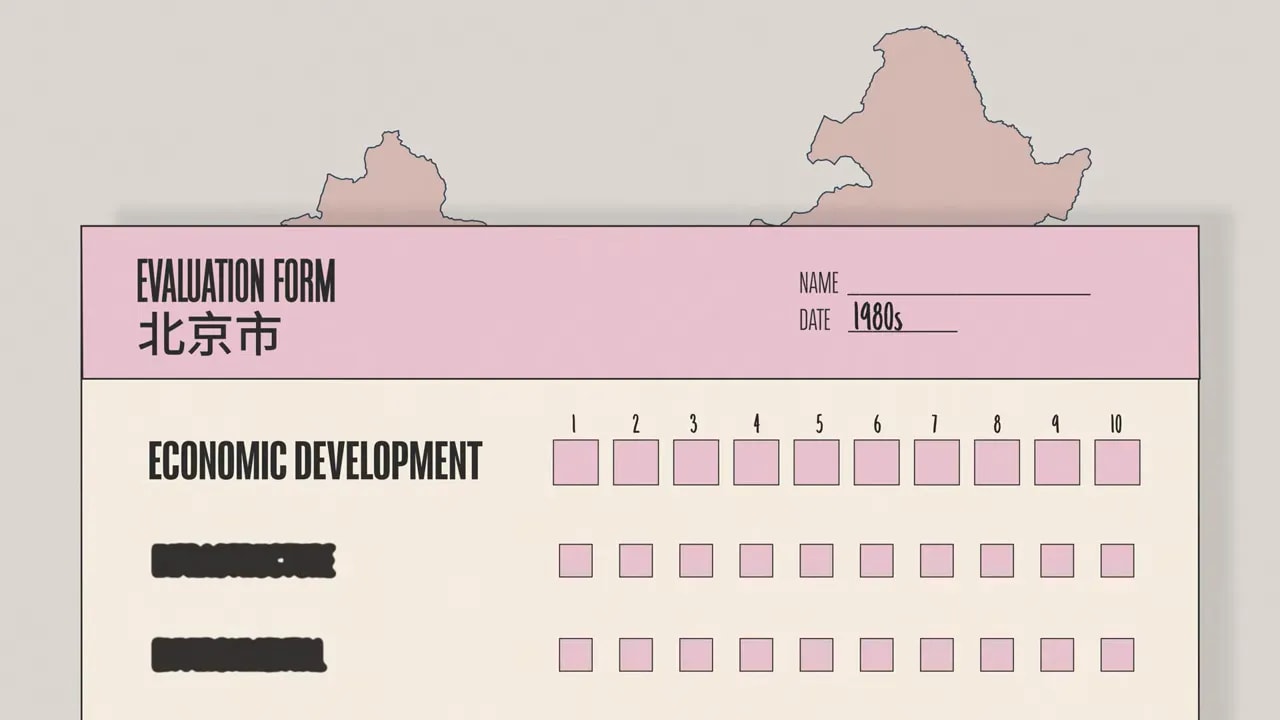
Suddenly, ambitious officials had a reason to find creative ways to attract businesses and generate economic activity. Experimentation, even pushing beyond established practices, could be rewarded when it produced results.
Deng also established Special Economic Zones, limited areas where China could experiment with investment, private enterprise, and market competition. Rather than transforming the entire economy overnight, the leadership created places to test a different approach.
This was not the disappearance of the party. It was the party changing the incentives inside its own organization.
“Separate Kitchens” Turned Local Governments Into Economic Players
Personal ambition was only one part of the equation. Deng also changed the financial incentives facing local governments themselves.
During much of the Mao era, local revenue flowed upward to the central government, which allocated budgets back down. This arrangement was described as eating from one large communal pot.
The problem was straightforward: if bringing in more revenue did not meaningfully improve your own budget, why work especially hard to generate it?
Under the fiscal arrangements associated with Deng’s reforms, local governments sent an agreed amount of revenue to the center and could retain additional revenue. The metaphor changed to eating in separate kitchens.
Now there were two incentives operating together:
- Officials could advance their careers by growing the economy.
- Their governments could keep more money when that growth generated additional revenue.
Local governments did not merely encourage business. In many rural areas, they entered business themselves.
The rise of township and village enterprises
Township and Village Enterprises, or TVEs, became an important engine of rural industrialization.
A town or village could establish a factory, select its managers, help secure land and bank financing, and benefit from its success. Public or collective ownership operated alongside market-oriented production.
These enterprises helped turn agricultural communities into industrial ones. Farmers became factory workers without necessarily moving to a distant metropolis.
The idea had its own memorable expression: leaving agricultural work without leaving the countryside.
It was a strange fit for the simple capitalism-versus-communism categories. But it worked well enough to help communities get richer and local officials move up.
Then the rules changed again.
How Land Financing Made Building the Best Game in Town
By the 1990s, the central government wanted a larger share of the revenue generated across China. The 1994 fiscal reforms shifted more tax income toward Beijing.
For local governments, that weakened the financial appeal of some of the industrial activity they had helped create. Factories could still generate growth, but more of the resulting tax revenue went to the center.
The pressure to deliver economic development remained. Local officials needed another source of money.
And they had access to something enormously valuable: land.
The land-financing cycle
Remember the distinction between state-owned urban land and collectively owned rural land. That distinction became central to a new development model.
- Acquire rural land. Local authorities requisitioned land from village collectives, compensating residents but not conducting an ordinary voluntary purchase.
- Convert and develop it. The land became state-owned, and authorities added roads and other infrastructure.
- Lease the land-use rights. Improved access and infrastructure made the parcel more valuable to developers.
- Retain the proceeds. Local governments could keep this revenue rather than sharing it with Beijing in the same way as tax income.
- Use higher land values to support borrowing. Land could serve as collateral, helping finance further construction.
Developers then built apartments, offices, or factories. That development could raise the value of surrounding parcels, making the next round more lucrative.
This became known as land financing, and it helped turn real estate and infrastructure into major engines of local economic activity.
Market demand still mattered. Developers wanted customers. But China’s system added another powerful incentive: building itself benefited local governments and the officials running them.
Construction generated jobs and economic activity. Land transactions generated revenue. New buildings offered visible evidence of achievement.
By the 1990s, GDP growth had become a particularly important, measurable “hard target” in official evaluations. Healthcare, education, and environmental protection could matter, but doing well in those areas did not necessarily compensate for failing to deliver growth.
So officials poured resources into roads, ports, telecommunications, airports, and real estate. Those projects could improve long-term productivity while also producing immediate economic activity.
If a superior arrived from Beijing or the provincial capital, a local leader could point to a new skyline or hotel and present a very concrete account of success.
National Plans Met Local Ambition
Of course, a competition among local officials cannot explain every major infrastructure project.
The Three Gorges Dam required national coordination. So did China’s enormous expansion of high-speed rail. No single city leader could build a connected network across the country.
But national planning and local incentives were not competing explanations. They could reinforce each other.
A local official had good reasons to want a high-speed rail station: more economic activity, higher surrounding land values, additional development, and a stronger record of delivering growth.

That alignment helps explain the speed and scale of construction. The center could pursue a national project while officials along the route wanted to make it happen in their own jurisdictions.
The result was not simply one leader issuing commands. It was an enormous, politically organized competition to develop, grow, and build.
What about bridges to nowhere and ghost cities?
The same system also produced puzzling outcomes.
Guizhou, a mountainous and relatively poor province in southwestern China, built an extraordinary network of highways and bridges. Some span enormous gorges. Its infrastructure can seem disconnected from its income level or immediate traffic demand.
Then there are the places that became famous as Chinese “ghost cities,” including Kangbashi in Inner Mongolia and Zhengdong in Henan. Large districts appeared to have been constructed before enough people were ready to occupy them.
But the story did not always end with empty buildings. People eventually moved into many of those places, and infrastructure that once looked unnecessary gained users.
That distinction matters. An empty district at one moment is not conclusive proof that building it was pointless. Sometimes construction had simply moved far ahead of demand.
Still, the system depended on a major assumption: more people, businesses, and buyers would keep arriving.
In a huge, rapidly urbanizing country, that was often a reasonable bet. It was never an unlimited one.
You Can Only Make That Economic Transformation Once
China’s growth model helped produce dramatic changes within a generation. Farmers became factory workers. Their children went to college, found different jobs, bought apartments, and entered a much more prosperous world.
But the same transition cannot happen repeatedly at the same scale.
Moving people from low-productivity agricultural work into industry can generate enormous gains. Building the first essential roads and connections can unlock tremendous value. Once much of that transformation has happened, the next project may deliver less.
The model encounters diminishing returns.
China’s economic growth slowed after the extraordinary decades of expansion. The impressive infrastructure did not disappear, but the conditions that produced it were changing.
That is easy to miss when looking at a futuristic skyline. Much of what feels like a glimpse of China’s future is also the accumulated result of a particular historical period: roughly four decades of rapid development shaped by Deng’s reforms and the incentives that followed.
Why outsiders’ excitement can miss the mood inside China
A Newpress member named Vivian, who had spent substantial time in Shanghai and had close Chinese friends, described an interesting disconnect. Some of her friends found foreigners’ amazement at China genuinely amusing.
Outsiders noticed the infrastructure. Citizens were living with a much wider set of experiences and expectations.
Among some younger Chinese people, the phrase “lying flat” became shorthand for stepping back from an exhausting competition that no longer seemed guaranteed to produce prosperity.
The government’s handling of COVID also alienated many people. The expectation that each generation would rapidly become much better off was no longer as secure.
That creates a political problem. Deng’s reforms were partly designed to protect the party by delivering prosperity. If that machine slows, the question of how the party maintains its position becomes more urgent.
And that brings us to the other major item on the officials’ scorecard.
Growth Was Only One Target. Stability Was the Other.
To understand this part of China’s system, we need to return to the late 1980s and early 1990s.
The Communist Party was confronting existential threats. Communist governments in Europe were falling. The Soviet Union, the original model for China’s political system, was coming apart.
Inside China, students and workers were protesting, most famously in and around Tiananmen Square in Beijing. Their aspirations went beyond economic growth.
Deng supported sending in the military to crush the movement in 1989. The crackdown killed large numbers of civilians, with the precise death toll still uncertain.
The reformer who had decentralized economic decision-making was also prepared to use lethal force to preserve party rule. Economic pragmatism did not mean a willingness to surrender political control.
During the 1990s, many Americans assumed that a richer, more globally connected China would eventually become democratic. But prosperity and political liberalization did not automatically travel together.
The party was actively designing its system to prevent that outcome.
A hard target versus a veto target
Economic growth was a hard target: something officials could measure and compare.
Social stability became a veto target. Failure could override achievements elsewhere and derail an official’s advancement.
Stability covered a range of concerns, including crime and terrorism, but suppressing protests and other “mass incidents” was central to it.
For a local official, that created two powerful pressures:
- Generate economic activity.
- Prevent unrest that could threaten the government or party.
Those objectives could collide. Building often required taking land or demolishing homes. Some residents received adequate compensation; others did not. People who refused to leave could be forcibly removed.
The same project that improved an official’s growth record could create the protests that ruined their career.
The Coercion That a Skyline Does Not Show
So how do you push development through while keeping public anger from rebounding onto the party?
Political scientist Lynette Ong describes forms of repression that can operate through intermediaries and community relationships, rather than only through uniformed police.
Intimidation with distance from the state
One approach involves using informal enforcers to intimidate people resisting demolition or land acquisition.
Officials can benefit from the pressure while denying responsibility, portraying the intimidation as the behavior of unrelated troublemakers.
The coercion is real. The official connection is made harder to establish.
Pressure from people you know
Another approach relies on respected community members, often retirees who have held local roles.
Some genuinely believe development will benefit the neighborhood. They may volunteer to persuade holdouts to accept an agreement.
But persuasion can become intense social pressure: everyone else has agreed, your refusal is holding back the community, and your neighbors’ futures are being sacrificed to your stubbornness.
You do not need to be arrested to find yourself isolated and pressured into compliance.
These practices help explain why a visitor can have a very positive experience without encountering obvious repression. A beautiful district does not reveal the land dispute that preceded it or the pressure placed on the people who lived there.
Nor does every citizen experience coercion directly. But an experience can be widely understood without happening to everyone. The absence of visible force on a particular street does not tell us how the system works when someone stands in its way.
Under Xi Jinping, the security apparatus has also expanded substantially. Estimates cited in the reporting put the number of surveillance cameras at roughly 30 million around 2013 and more than 200 million by 2019.
Those estimates are not a complete measure of repression. They do illustrate the scale of the expanding surveillance infrastructure.
Xi’s China Is Moving Beyond the System That Built the Boom
Scholars often describe an implicit bargain between the party and the population: the party delivers prosperity, stability, and security, while citizens do not get to choose who governs them.
What happens when delivering rapid prosperity becomes much harder?
There is no settled answer. But Xi is already changing important parts of the system that shaped the boom.
GDP growth no longer has the same weight in official evaluations that it once did. Loyalty and ideology have become more important.
There are reasons to move away from an overriding obsession with growth. The old incentives encouraged overbuilding and speculation as well as genuinely useful development. Continuing indefinitely was not a realistic option.
But changing those incentives also means changing the machinery behind much of the China that amazes outsiders.
The bridges and skylines remain. They are, in part, an echo of an earlier era. They do not tell us exactly what comes next.
The Lesson Is About Incentives, Not Giving Up Rights
China’s infrastructure is genuinely impressive. Its economic transformation was genuinely extraordinary. Neither fact requires ignoring displacement, coercion, uneven experiences, or the limits of the growth model.
But the opposite mistake is also easy: treating authoritarianism as a complete explanation for everything China built.
Plenty of democracies have excellent trains. Plenty of autocracies do not.
The useful question is not simply how much power leaders possess. It is what they are encouraged to do with that power.
China’s building boom emerged from a particular combination: a party-state capable of directing careers, decentralized economic experimentation, promotion incentives tied to growth, fiscal rules that rewarded local revenue, and a land system that made construction especially attractive.
The achievements and the harms came from that same system.
In China, those incentives were shaped largely from above, through the party. In a democracy, citizens have the power to help shape them from below, by holding leaders accountable.
So the question comes back to us: What do we choose to reward?
Sources and Original Video
This article is adapted from The REAL reason China built so much, created by Johnny Harris and his team. Full credit for the original video, reporting, and explanation belongs to the Johnny Harris YouTube channel.
The reporting includes contributions from producer Adam and interviews with Max Fisher, Bruce Dickson, Andrew Fedorov, Lynette Ong, Victor Shih, and Dan Wang. The team’s source collection and additional reading list provide further material on China’s development.

Be the first to comment