


A tax refund arrives. A plane lands safely. A weather forecast gives a community time to prepare. None of these events usually inspires much gratitude toward Washington. That, Michael Lewis argues, is both the achievement of effective government and the source of its vulnerability: when it works, it disappears into everyday life.
In Blockers, Lewis turns his attention to the career public servants caught in the effort to reshape the federal government during Donald Trump’s second administration. His central question is not simply what the administration is doing. It is what the country loses when experienced people, independent oversight, and long-term scientific work are pushed aside.
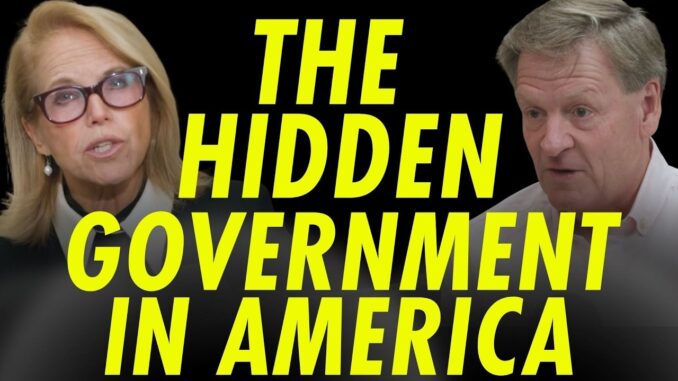
In a conversation on Katie Couric’s YouTube channel, Lewis makes a sharp distinction between reforming government and making it personally loyal to a president. Couric presses him on the obvious complication: surely government can contain admirable people and still be inefficient. Their exchange becomes something more useful than a blanket defense of bureaucracy. It asks what deserves protection, what needs rebuilding, and how Americans can tell the difference.
From Neglect to Control
Lewis had already explored the federal government in The Fifth Risk, which grew out of his concern that the first Trump administration neither understood much of the machinery it inherited nor showed much interest in learning.
He would not have written another book, he explains, if the story had remained the same. What drew him back was a change in purpose.
His characterization of the first administration is neglect and indifference. His characterization of the second is an intentional effort to disable institutional independence and turn the executive branch into a loyalist operation.
The distinction matters. A civil service whose roughly two million employees take an oath to the Constitution is different from one organized around the personal interests of whoever occupies the White House. Many of those employees perform work that is not inherently partisan: collecting taxes, producing statistics, studying fires, protecting public health.
Lewis’s concern is not merely that government might become smaller. It is that its obligations might change. A larger government can still serve a narrow political purpose if loyalty becomes the organizing principle.
He sees Elon Musk’s DOGE operation as the opening assault, not the entire project. Its early disruption, in his telling, sometimes resembled the first administration’s lack of knowledge. But it also established something more deliberate: the administration could remove people, dismantle operations, and demonstrate who held power.
The Chainsaw Spectacle and the Question of Savings
Couric recalls the celebratory atmosphere surrounding the cuts: the chainsaw imagery, the insults, the public mockery of people losing their jobs. Why, she asks, did that apparent delight in destruction not provoke more outrage?
Lewis first challenges the premise that the spectacle represented a successful shrinking of government. He contrasts Musk’s initial ambition to cut $2 trillion with later claims of savings in the hundreds of billions. Citing a New York Times examination, he says the identifiable savings were far smaller, while paying employees not to work created substantial costs of its own.
His larger argument is that dramatic announcements and verified net savings are different things. So are removing waste and eliminating services people actually want.
He does not claim to know Musk’s precise motives. Instead, he argues that the public performance helped sell a familiar story to Americans already inclined to believe government itself was the problem. In his interpretation, the underlying project was less about reducing government than controlling it.
That interpretation also shapes his discussion of Russell Vought, the director of the Office of Management and Budget. Lewis points to Vought’s recorded remarks about wanting federal workers to experience trauma at work as evidence that intimidation was part of the strategy.
Drawing on an Orwellian conception of power, Lewis suggests that compelling people to suffer can become a demonstration of authority in itself. Couric’s question about callousness is therefore not a detour from the policy discussion. It goes directly to what Lewis believes the exercise was meant to accomplish.
Government Can Be Admirable and Still Need Reform
Couric refuses to let admiration for public servants end the argument. Why can the answer not be both? Many federal employees deserve recognition, and the institutions around them can still be bloated, frustrating, or inefficient.
Lewis agrees that thoughtful restructuring is necessary. What he rejects is the assumption that a federal agency should behave like a startup.
Government cannot simply move quickly and accept whatever breaks. When the work involves aviation, disease prevention, food safety, or drinking water, the consequences of failure can be enormous. Some safeguards that look cumbersome exist because avoiding a catastrophic mistake matters more than moving fast.
Yet Lewis is hardly complimentary about the management structure. He describes career employees working beneath political leaders who may know little about the agencies they run, arrive because of their connection to a president, and leave before developing much institutional understanding.
He identifies several recurring obstacles:
- Leadership churn: Political appointees can turn over much faster than a presidential term, disrupting priorities and continuity.
- Uncertain budgets: Agencies must plan around congressional funding decisions that can fluctuate sharply.
- Too many political appointments: Lewis argues that the more than 4,000 political positions should be reduced dramatically, suggesting something closer to 200.
- Technology and recruitment problems: He recalls an estimate that fewer than 5 percent of federal IT employees were under 30, while more than half were over 55. He presents those figures as approximate, but uses them to underscore the need for renewal.
His defense is primarily of the people trying to work within that system. He describes employees who accept lower salaries to pursue unusually specialized missions and operate under stringent ethical restrictions. An offer to buy a federal worker lunch, he notes, can prompt an anxious refusal.
He also distinguishes fraud committed against government, such as tax evasion or Medicare fraud, from misconduct by career employees. Treating every example of public money being stolen as evidence that civil servants are thieves, he argues, confuses the perpetrator with the institution being exploited.
Independence as a Form of Institutional Strength
For Lewis, reform should move toward depoliticization rather than greater presidential control.
He points to the Federal Reserve as an example of an institution whose distance from day-to-day politics has helped it function. Conversely, he argues that the politicization of leadership at the Centers for Disease Control and Prevention weakened the institution over time, contributing to failures he explored in his writing about the pandemic.
These are Lewis’s interpretations of institutional history, but the principle connecting them is straightforward: some public responsibilities require expertise and continuity that extend beyond an election cycle.
Clean water, safe food, reliable public-health systems, and confidence in air travel are not obscure ideological projects. They are shared expectations. The challenge is designing institutions that can meet those expectations while still improving.
Why the Work Remains Invisible
Government has a storytelling problem, and Lewis believes it is partly self-inflicted.
The people drawn to economic statistics, weather forecasting, or scientific research are not necessarily interested in advertising themselves. Even when they have compelling stories to tell, political leadership may restrict access. Lewis describes appointees who regard publicity as a risk and resist allowing reporters to explore what career employees actually do.
When a success does become public, a politician often receives the credit. When something fails, the bureaucracy becomes the story.
That asymmetry makes it easy to assemble a persuasive case that government is useless. An organization with millions of employees and an enormous range of responsibilities will inevitably make mistakes. Failures produce visible events. Prevention often produces nothing that can be photographed or announced.
Lewis’s work on The Fifth Risk and Who Is Government? offered the opposite experience: getting close to agencies revealed capable, distinctive people doing consequential work. Among the examples he discusses is fire researcher Alex Maranghides, whose work examines how wildfires spread into communities such as Paradise and Pacific Palisades.
The public may know the disaster. It is much less likely to know the person developing tools to reduce the next one.
How Federal Workers Became an Enemy
Couric asks why labels such as “the swamp” and “the deep state” have become so powerful. Lewis sees them as part of a longer American narrative that casts government as an alien force rather than a democratic institution funded and directed by the public.
He also places the demonization of federal workers within a broader politics of grievance. In his analysis, anger seeks a target, and immigrants, transgender people, and government employees have been made into outsiders against whom resentment can be directed.
What particularly puzzles him is the limited institutional defense from politicians who know what agencies do. Members of Congress fund the executive branch. They have programs they value and projects important to their constituents.
They may object forcefully when a military base in their state is threatened or a favored initiative is cut. Lewis sees less willingness to defend the larger system that makes those individual programs possible.
Once a group has been successfully vilified, defending it carries political risk. But he argues that the practical stakes eventually make silence impossible. Government capacity affects water, transportation, national security, and the country’s ability to understand emerging technologies such as artificial intelligence.
Why Lewis Calls His Subjects “Blockers”
The title Blockers reclaims a term Lewis says Musk used for people standing in the way of his team’s plans. In Musk’s formulation, blockers were obstacles to identify and remove.
Lewis heard something different: people attempting to honor their responsibilities even when resistance offered little personal benefit and substantial professional risk.
He wanted to turn an insult into a distinction. The relevant question was not whether someone obstructed change, but what that person was protecting and why.
That idea gave him the book’s structure. Rather than keep the focus on Trump, he would describe the people and functions that could no longer survive in the altered institution.
He organized his reporting around several basic government responsibilities:
- Public safety
- Scientific research
- Regulation, law, and independent oversight
- Data collection and reliable information
He describes this as a negative-space approach: draw attention to what has disappeared, and the larger transformation becomes visible.
The reporting process reminded him of The Big Short. He knew the broad shape of the story and found several possible people who could illuminate each part. Choosing among them became a kind of casting exercise, with human relationships making institutional conflict tangible.
A Security Officer at the Institute of Peace
The book opens with Colin, the security officer who tried to prevent DOGE from taking over the U.S. Institute of Peace in March 2025.
Before discussing the confrontation, Couric asks a useful question: what exactly is the Institute of Peace?
Lewis describes a congressionally created nonprofit established during Ronald Reagan’s presidency, supported by public funding and private donations, with an independent governance structure. Its building, he emphasizes, belonged to the institute.
Its mission was conflict prevention and resolution. Its position at some distance from the government could allow it to speak with people, including Iraqi tribal leaders, without every encounter functioning as a direct U.S. government negotiation.
Lewis recounts its work bringing hostile factions together in Iraq’s so-called Triangle of Death. He says David Petraeus credited the institute with saving American lives and producing benefits far beyond its costs.
A Dispute Over More Than a Building
In Lewis’s account, Colin initially turned DOGE representatives away. When the confrontation escalated, the institute’s security contractor faced pressure over its larger State Department business. Lewis alleges that the contractor, D.C. police, and the FBI ultimately aligned with the takeover effort.
Colin, a former military serviceman and Baltimore police officer, understood the intrusion as a trespass on private property. Lewis describes a cat-and-mouse encounter in which Colin used the building’s security systems to frustrate the effort, including locking doors after opposing personnel entered a room.
Police eventually removed him and later released him. At the time of the conversation, Lewis says, he was employed by a private security firm.
For Lewis, the episode matters because it tested the reach of executive power. He interprets it as an assertion that anything even loosely connected to the executive branch could be seized and controlled. The absence of gunfire did not make the imbalance of force irrelevant.
Couric also raises the institute’s subsequent legal effort to prevent Trump’s name from being carved into its headquarters. The dispute over the facade extends the conversation’s central question: does proximity to government make an institution the president’s personal possession?
When Public Accusations Have Human Consequences
Lewis’s criticism becomes especially forceful when he discusses Musk’s public claims about what DOGE found at the institute.
He says those claims included distortions and false allegations. Musk declined to speak with him for the book, Lewis notes, so his reporting included conversations with associates sympathetic to Musk. Some offered the defense that Musk believed what he said, even when it was untrue.
Lewis finds little reassurance in that distinction. The consequences of broadcasting false information do not depend solely on whether the speaker believes it.
His most disturbing example concerns an Afghan who, Lewis says, had worked closely with American officials, including helping prepare negotiations with the Taliban during Trump’s first administration. Lewis alleges that Musk publicly misidentified the man as a Taliban member after information about institute payments was found.
Lewis says the Taliban subsequently detained and tortured the man’s relatives in Afghanistan. He cites ProPublica’s reporting on the episode and argues that the consequences received far less attention than they warranted.
The account brings his broader concern down to its most concrete level: a public allegation made to discredit an institution can expose people far beyond Washington to danger.
Trust and the Government’s Referees
Asked about Trump’s desire to attach his name and image to public institutions, Lewis says he finds Trump’s causes and consequences more interesting than his personality.
He offers a rule of thumb for understanding the president’s behavior: look for places where trust exists, and consider how undermining it might serve him.
Lewis applies that interpretation to the Federal Reserve, Treasury obligations, the justice system, and the media. His argument is that someone regarded as untrustworthy benefits when everyone else’s credibility is also brought into doubt.
The institutional version of that problem appears in what he calls government’s refereeing function.
Financial regulators and inspectors general are supposed to enforce rules without favoring the powerful. Like referees in a basketball game, they ideally do their work without becoming the main attraction.
Remove the referees, Lewis argues, and the strongest players gain an advantage. Rules give way to power relationships. In his view, attacks on independent oversight do not merely change personnel. They change whether fairness is possible.
The effects may emerge gradually, he cautions. Removing a safeguard can happen much faster than the failures that reveal why it existed.
The DOGE Recruit Who Actually Wanted to Fix Something
Sahil Lavingia complicates any simple account of the people who joined DOGE.
Unlike younger recruits Lewis describes as hoping to get close to Musk, Lavingia arrived with substantial professional success. He had been an early Pinterest engineer and founded Gumroad. He had already made enough money to choose a different kind of work.
His motivation was refreshingly specific: he was irritated by outdated government technology. Why was the IRS sending paper? Why had a refund check gone to an old address? Why could dealing with taxes not be more straightforward?
Instead of initially going to the IRS, he was assigned to the Department of Veterans Affairs.
There, Lewis recounts, Lavingia encountered another DOGE recruit reviewing a file containing roughly 90,000 contracts. The recruit was searching for terms such as “gender,” “trans,” and “bias,” then cutting contracts containing those words without properly examining their purpose.
Lavingia found the process bizarre. In Lewis’s telling, the other recruit effectively agreed but had no better method for carrying out the instruction to cut.
It was a revealing collision between two ideas of reform: understanding an institution well enough to improve it, and producing visible reductions regardless of what they removed.
Lavingia later told a Fast Company reporter that he had been surprised by how efficient parts of government were. Lewis says that assessment damaged his standing within DOGE, and he was subsequently fired.
The Public-Service Impulse Survives
What interests Lewis most is that Lavingia did not simply retreat to private business. When another opportunity to improve government arose, he returned.
Lewis describes him contemplating a decade working on IRS problems rather than maximizing his earnings in technology. That willingness matters to the book’s outlook.
Lewis does not believe Americans are inherently selfish or cynical. He believes many people will help if institutions give them a credible way to contribute.
The goal, then, is not to restore every feature of the old system. It is to create a better one in which capable people can improve services, make meaningful sacrifices, and receive something other than contempt for becoming government workers.
Francis Collins and the Loss of Long-Term Science
Francis Collins is the best-known public servant discussed at length. He led the National Institutes of Health under three presidents and directed the Human Genome Project.
Lewis chose him to explore a particularly difficult loss to measure: scientific work whose benefits may take decades to appear.
Research is not a predictable production line. A project may lead to a treatment, illuminate an entirely different problem, or fail to deliver the hoped-for result. Lewis argues that this uncertainty does not erase its public value. He cites economic research suggesting that NIH spending produces returns beyond the original investment, apart from its health benefits.
Collins’s story also contained a mystery. Although his departure was publicly described as a resignation, Lewis says Collins told him he had been fired and ordered out of his laboratory.
At the time, Collins was researching diabetes and progeria, a rare condition that causes rapid aging. Lewis emphasizes that studying a rare disease can also reveal principles with broader applications. Even without such spillover benefits, he argues, the patients still deserve scientific attention.
A Career Ending Told as a Murder Mystery
Collins did not know who had ordered his removal, according to Lewis. There were several possible figures, with different potential motives.
That uncertainty suggested a literary structure: a closed-room murder mystery. The “murder” is explicitly a metaphor for Collins’s removal from his work, not a physical attack.
Lewis believed that examining the possible motives could reveal multiple sources of hostility toward science, including religious and ideological objections to particular kinds of research.
The most painful connection involved Vought. Lewis says Vought has a daughter with cystic fibrosis whose treatment depended on decades of research, including Collins’s role in identifying the gene associated with the disease.
Lewis does not establish that Vought personally ordered Collins’s dismissal. His argument is that Vought had the power to intervene and did not. The contrast between the benefits of scientific work and the willingness to dismantle its institutional home gives the story its moral force.
When Ideology Overrides Personal Gratitude
Lewis sees similar connections elsewhere. Maranghides, the fire researcher, also conducted major experiments that helped explain how fire contributed to the World Trade Center collapses.
Lewis connects that work to Commerce Secretary Howard Lutnick, whose brother and many Cantor Fitzgerald colleagues died in the September 11 attacks. He criticizes efforts under Lutnick’s department that, in his account, threatened Maranghides’s work.
These relationships were part of Lewis’s selection process. He wanted to show that institutional destruction is not always impersonal. The people directing it may have benefited profoundly from the work they are attacking.
Couric asks whether the pursuit of power can override morality and gratitude. Lewis’s answer is yes: political identity can supply permission to disregard values that would otherwise guide behavior.
Ignorance can make that easier, he argues. Understanding what a scientist, regulator, or security officer actually does creates an obligation to reckon with the consequences of removing them. Not knowing helps keep those consequences abstract.
Anthony Fauci and the Erosion of Care
Although Anthony Fauci is not a central figure in Blockers, Couric asks whether the hostility toward him belongs to the same larger story.
She distinguishes criticism of his mistakes or public persona from dismissing decades of public service. Lewis agrees. Managing a pandemic under Trump inevitably involved errors, he says, but he views Fauci’s work as an effort to help people.
Lewis interprets the American pandemic experience as a failure of collective care. He recalls the country’s disproportionate share of recorded deaths early in the crisis despite its wealth and preparedness.
Turning the doctor into the enemy, in his telling, reflects a deeper breakdown: the weakening of the belief that people and institutions might be trying to look after one another.
Collins offered Lewis the more compelling narrative structure. Fauci, he suggests, could have illuminated another part of the same problem.
A Different Kind of Story: Grief and the Stage
The conversation closes with a turn away from Washington. Lewis describes writing How to Be Lucky, a one-person play about the death of his daughter Dixie and the particular experience of grief.
At the time of the interview, the production was planned for the Cherry Lane Theatre, with Hamilton director Thomas Kail directing. Edward Norton had participated in a reading, but Lewis says casting remained undecided.
He is animated by the challenge of finding a form for intensely personal material. The play, he suggests, will not leave people with the experience its subject might lead them to expect.
It is a quieter ending to a conversation filled with anger. But the link to his government reporting is recognizable: large abstractions become understandable through particular people.
The Question After the Cuts
Lewis’s case is not that every agency works well, every employee performs brilliantly, or every existing structure deserves to survive.
It is that those judgments require knowledge. Reform should begin by understanding the work, the people doing it, and the risks they manage.
The public servants in Blockers also point toward what might come next. Lewis imagines them being asked not simply how to restore what existed, but how to rebuild it better.
That leaves a more demanding question than whether government is good or bad: which capabilities does the country need, what independence do they require, and what happens when they are gone?
The plane that lands safely will rarely make that argument for itself. Someone has to explain the work that helped it arrive.
The Original Conversation
This article is adapted from Katie Couric’s interview with Michael Lewis, “America’s Secret Government: Who Really Runs America?” The full conversation appears below.
Adapted for readers by #teamHJB of ReelToRead.com — turning great videos into even better reads.

Be the first to comment