


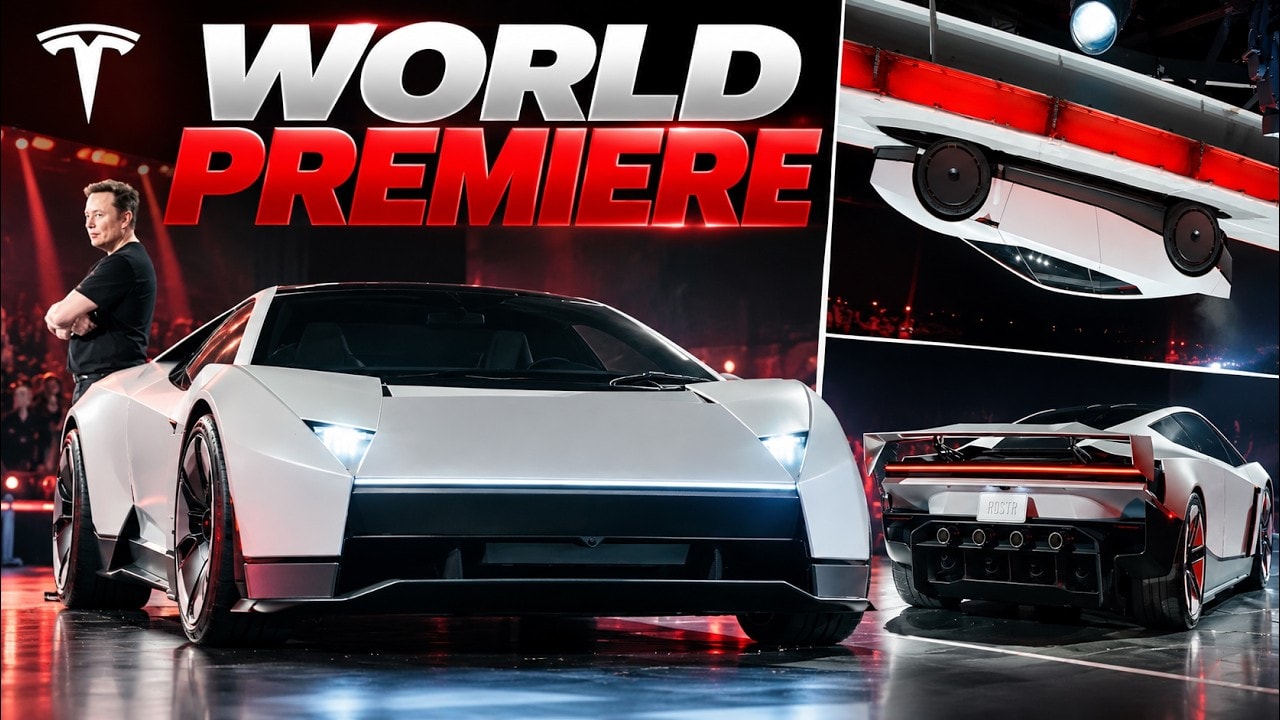
A sports car that clings upside down to a ramp, launches on compressed-air thrust, and performs an airborne flip is not the usual answer to the electric supercar question. But the next-generation Tesla Roadster presentation makes conventional performance look almost restrained.
At SpaceX’s 4,000-acre rocket testing and development site in McGregor, Texas, Elon Musk and Tesla’s presenters outlined a machine intended to combine electric-car engineering with aerospace technology. Its ambitions extend from extraordinary cornering grip to a claimed subsecond sprint to 60 mph, with production targeted for 2028.
The important distinction is between the spectacle and the finished product. The presentation offers demonstrations, engineering claims, and development goals, not independently verified production specifications. That caveat matters for a car whose proposed capabilities include briefly leaving the ground.
Key Takeaways
- The Roadster presentation combines fan-generated suction, active aerodynamics, and compressed-air thrusters to pursue extreme grip and acceleration.
- A live 0-to-60 result of approximately 0.881 seconds is announced, but it is not an independently verified production specification.
- Reported Performance, Thrust, and Rocket configurations differ, and the demonstrated two-seat car does not establish every version’s final equipment.
- Production is targeted for 2028, with final specifications, pricing, and legal approvals still unresolved in the presentation.
Table of Contents
- From Proving Electric Cars Work to Pushing Their Limits
- The Upside-Down Demonstration Has a Track-Day Purpose
- Ten Nozzles, Two Pressure Vessels, and Compressed Air
- A Two-Seat Cabin With Aerospace Priorities
- The Subsecond 0-to-60 Claim
- Performance, Thrust, and Rocket: Reported Configurations
- Beyond 230 MPH, With Production Targeted for 2028
From Proving Electric Cars Work to Pushing Their Limits
The presentation begins by returning to the original Roadster’s purpose: proving that an electric vehicle could be desirable, enjoyable, and capable of traveling meaningful distances. Tesla’s subsequent progression through Model S, Model 3, and Model Y provides the backdrop for a very different assignment.
This Roadster is not presented as another step toward affordable transportation. Instead, Musk describes it as the car that would preserve human driving within Tesla’s increasingly autonomous future. His stated long-term intention is for it to become the only manually driven vehicle Tesla makes.
That does not mean every demonstration involves a driver. Musk explains that the stunt car operates autonomously for safety. The distinction is central to the pitch: automated control handles the most extreme exhibition maneuvers, while the proposed customer car is framed around driving enjoyment.
The SpaceX connection also comes with a familiar reference. The presenters recall the earlier Roadster sent into space with Starman aboard. Here, that relationship moves from symbolic cargo to technology integrated into the vehicle itself.
The Upside-Down Demonstration Has a Track-Day Purpose
The first major stunt uses a towering curved ramp. The Roadster travels up the structure, holds an inverted position, and later leaves the ramp before returning to the ground with visible thrust and a cloud of vapor.
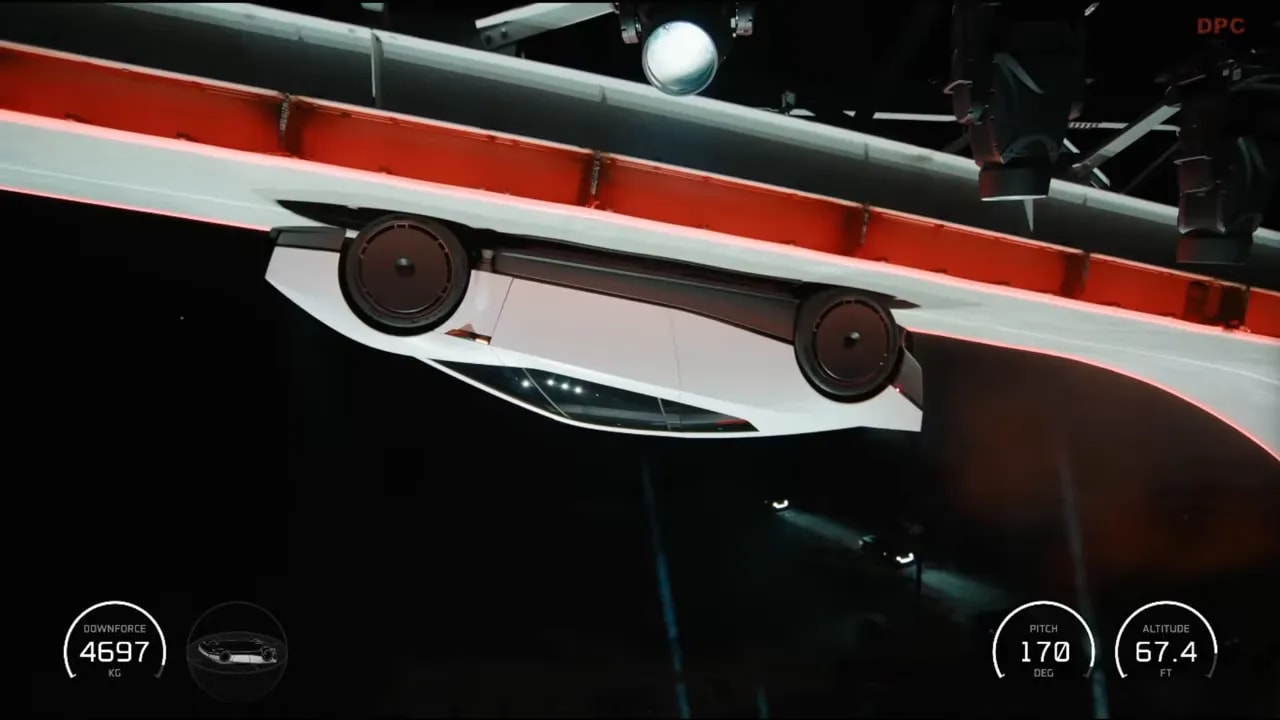
The explanation centers on a fan-driven suction system beneath the car. Tesla’s presenters say it can generate downward force equivalent to as much as 2 g, enough in the demonstration’s intended operating conditions to hold the vehicle upside down.
Driving inverted is the attention-grabbing application. The more relevant one is tire grip.
By pulling the vehicle toward the surface, the system is intended to improve both acceleration and cornering. The presenters claim lateral acceleration above 2 g, contrasting that with an approximately 1.26 g tire-traction figure cited during the presentation.
The engineering ambition is therefore broader than a spectacular launch. Tesla wants a car that can apply more force through its tires and carry exceptional speed through corners. Musk predicts sweeping track-record improvements, although the presentation supplies no independently verified lap times to establish that outcome.
Ten Nozzles, Two Pressure Vessels, and Compressed Air
The airborne portion of the Roadster concept relies on a separate system. Musk describes attitude-control thrusters for orientation and main thrusters at the rear, allowing rocket-like control during brief flights and rotations.
The presenters supply several unusually specific hardware claims:
- Two composite overwrapped pressure vessels store the compressed air.
- 600 liters of combined vessel capacity are described for the demonstrated system.
- About 250 kilograms of air are said to be carried.
- Ten nozzles provide the thrust used for the maneuvers.
Despite the rocket terminology, Musk says the system does not require a special propellant. It expels air stored at extremely high pressure, and the car is intended to recharge its own air tanks.
That answers one practical question without resolving all the others. The presentation does not establish how long recharging takes, how many maximum-effort maneuvers a full charge supports, or what restrictions would apply to customer use.
A second stunt sends the Roadster airborne over a lineup of Tesla vehicles, rotating in a maneuver the presenters call a kickflip. A Starman figure also appears, with an explicit clarification that it is not a human occupant.
Musk’s safety qualification is unusually direct: the vehicle is not being presented as optimized primarily for safety. He also acknowledges uncertainty about whether all of its capabilities would be legal in every jurisdiction. A demonstration of controlled flight is not the same thing as approval for everyday airborne travel.
A Two-Seat Cabin With Aerospace Priorities
Once the car arrives onstage, the presentation shifts from stunts to design. The stated inspirations include the SR-71 and transforming machines, but the exterior is described as deliberately clean rather than covered in obvious aerodynamic hardware.
The demonstrated cabin has two seats, with seating structures molded into the chassis as part of a lightweight approach. A compact steering yoke accompanies steer-by-wire steering, while braking and throttle control are also described as electronically controlled.

The rear diffuser area houses much of the equipment responsible for the car’s unusual behavior, including the fans and thruster hardware. The design challenge, as the presenters describe it, is to retain an attractive road-car shape while allowing the body to change configuration for performance.
Active Aerodynamics Work Alongside the Fans
The Roadster is described as having both high-downforce and low-drag modes. Its fan system also changes how it operates depending on speed.
- At low speed, suction is intended to pull the car down and increase available traction.
- At high speed, front and rear portions of the suction system open to increase airflow beneath the vehicle.
- A variable-pitch rear wing automatically adjusts downforce according to the car’s calculated needs around a circuit.
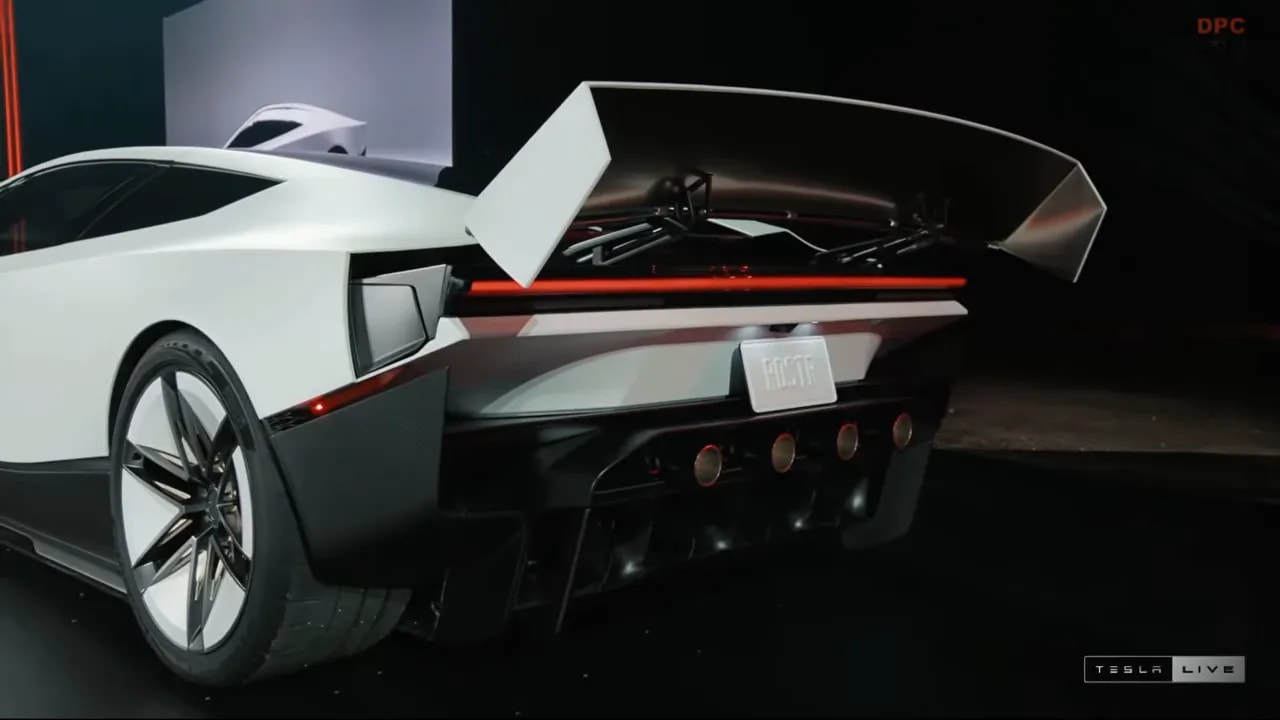
The systems are presented as complementary. Suction addresses grip at low speeds, while airflow management and the adjustable wing help tailor the car’s aerodynamic behavior as conditions change.
The Subsecond 0-to-60 Claim
The acceleration segment begins with a test sequence labeled as a one-second run to 60 mph. Musk then reiterates that his target is less than one second, prompting another demonstration.
The live timing discussion is initially confused, with an implausibly short number dismissed before a result of approximately 0.881 seconds is announced. DPCcars’ accompanying description instead reports 0.81 seconds. Those numbers should not be treated as interchangeable; the spoken announcement supports the approximately 0.881-second figure.
Either way, the essential claim is a subsecond sprint, not a verified production-car record. The presentation does not provide enough testing detail to establish a directly comparable, independently validated result.
The presenters attribute the launch partly to rear thrust, claiming more than 80 kilonewtons from four rear thrusters. They also describe supersonic exhaust flow producing Mach diamonds, the patterned shock structures associated with the jets.
Musk connects the development strategy to a simple relationship: acceleration increases when force rises or mass falls. He predicts the production car will improve on the demonstration result, while joking about the limits imposed by the human body.
The presentation also claims half-mile performance comparable in elapsed time to other cars’ quarter-mile runs, but supplies no specific time to substantiate that comparison.
Performance, Thrust, and Rocket: Reported Configurations
DPCcars’ accompanying information describes three proposed Roadster configurations. These details add context, but they should remain separate from what is established by the two-seat onstage car.
- Performance: Reportedly combines active aerodynamics with the multimode suction system.
- Thrust: Reportedly adds rear-mounted cold-gas thrusters.
- Rocket: Described as an invitation-only configuration with ten thrusters and a single-seat layout.
That reported single-seat Rocket layout differs from the two-seat vehicle demonstrated onstage. The presentation does not fully map every piece of demonstrated hardware to each proposed customer configuration.
The accompanying information also cites approximately 300 miles of driving range and reported reservation amounts of $50,000 for Performance and $250,000 for Thrust. Those reservation amounts are not final purchase prices, and the range figure is not presented as an independently verified production result.
Beyond 230 MPH, With Production Targeted for 2028
Near the close, the presenters state that the Roadster can exceed 230 mph. Musk pushes the ambition further, suggesting a target around Mach 0.5 or slightly above. These are different levels of claim: the first is a stated speed capability, while the second is a challenge for further development.
The same spirit carries into discussion of a possible future Snake River Canyon jump, invoking Evel Knievel’s famous attempt. Musk acknowledges uncertainty about whether it is possible. It is a proposed follow-up stunt, not an achievement demonstrated here.
The clearest commercial milestone is a stated production target of 2028. No detailed manufacturing ramp, final pricing schedule, or jurisdiction-specific approval plan accompanies that announcement.
That leaves the next-generation Roadster in an intriguing position. Its most consequential ideas may not be its airborne tricks, but the combination of active suction, adaptive aerodynamics, lightweight construction, and supplemental thrust. The presentation’s challenge is now to turn those ideas into a repeatable, usable customer product.
The original Roadster set out to make electric cars credible. This one is being pitched as proof that credibility no longer has to mean restraint.
Source credit: DPCcars on YouTube, whose coverage provides the presentation and accompanying vehicle information adapted here.
Adapted for readers by #teamHJB of ReelToRead.com — turning great videos into even better reads.


Be the first to comment