


We tend to imagine dying as a process of losing everything: strength, independence, awareness, connection. But what if physical decline is only part of the story?
In the final weeks of life, some people describe an inner world that becomes more vivid, not less. They feel reunited with a partner who died years earlier. They hear a parent’s voice. They revisit an ordinary kitchen table where everyone they love is together again.
These experiences do not remove the reality of death. Often, they change how a person feels about approaching it.
After nearly three decades in hospice care and interviews with approximately 1,500 dying people, Dr. Christopher Kerr offers a deeply human challenge to the way we think about life’s end. His work asks us to take the experiences of dying people seriously, rather than reducing their final days to failing organs and medical interventions.
The question is not only what happens when we die. It is what the dying can tell us about what matters while we are here.
Content note: This article discusses terminal illness, grief, trauma, and the deaths of children.
Key Takeaways
- Kerr’s research describes vivid end-of-life dreams and visions that often bring comfort through connection with deceased loved ones.
- Hospice patients prioritized relationships, comfort, and autonomy above longevity and resolving conflicts.
- Honest conversations about dying can preserve choice and help families prepare for loss.
- Physical decline does not necessarily end psychological growth, emotional healing, or hope.
Table of Contents
- What End-of-Life Dreams and Visions Actually Look Like
- How Deathbed Visions Differ From Ordinary Dreams and Delirium
- Is This Biological, Spiritual, or Evidence of an Afterlife?
- The Biggest Misconceptions About Dying
- What Dying Patients Actually Say Matters Most
- Do People Really Spend Their Final Days Thinking About Regret?
- Why Hospice Is Not Simply a Place to Go
- Living Well Is Different From Living as Long as Possible
- How Old Wounds Can Resurface, and Sometimes Heal
- How the Experience of Dying Shapes Grief
- Six Lessons From Caring for the Dying
- What Facing Cancer Changed for Kerr
- How Children Experience the End of Life
- What This Means for the Way We Live
- Original Conversation and Further Reading
What End-of-Life Dreams and Visions Actually Look Like
Kerr describes medical training as preparation to defeat death, not necessarily to care for someone who is dying. When he arrived in hospice, nurses helped him recognize something his education had largely overlooked: patients still had rich emotional and personal lives, even as their bodies weakened.
That became the starting point for his research. Instead of asking only what disease was doing to the body, he began asking what the person was experiencing.
In the research he discusses, nearly 90% of patients reported intense end-of-life dreams or visions. These experiences often became more frequent in the last week or two of life. Around half, he explains, occurred while the person was awake.
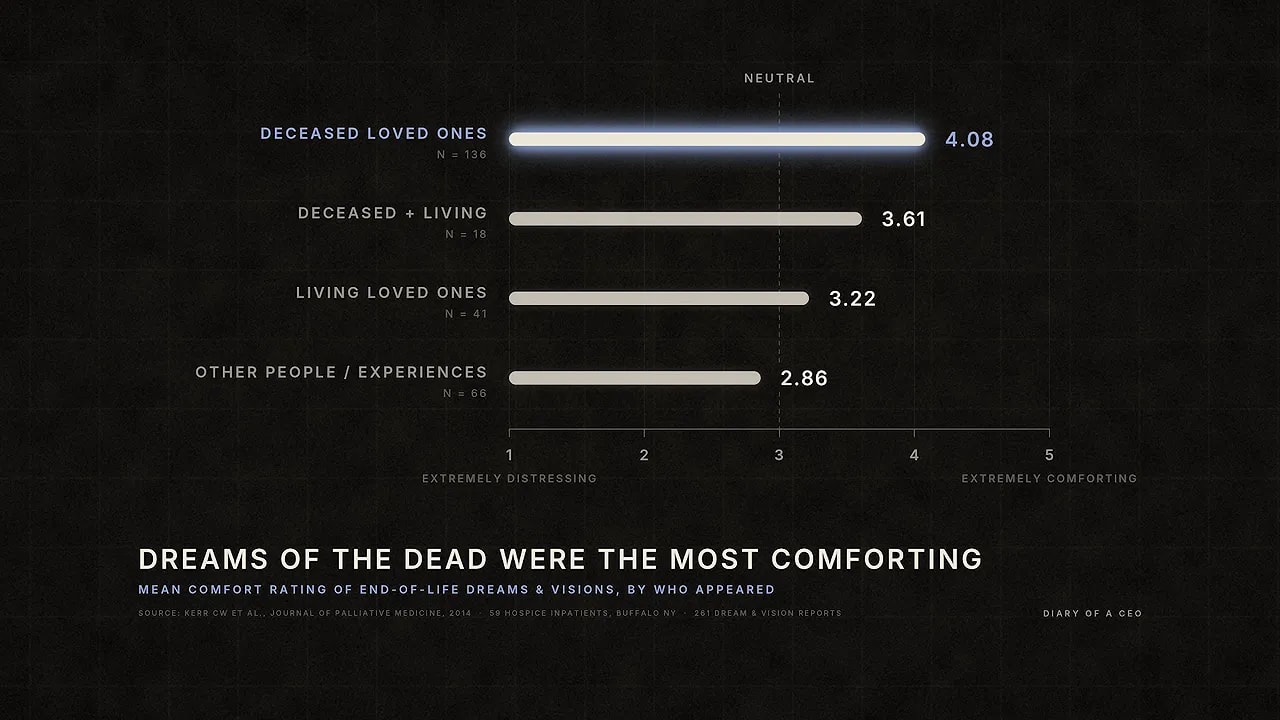
The recurring theme was connection, particularly with deceased loved ones who had made the person feel unconditionally loved.
- A deceased spouse might appear healthy, smiling, and reassuring.
- A parent lost in childhood might return with a vividly remembered voice or scent.
- A childhood pet might feel present again after decades.
- A familiar meal or family gathering might restore a sense of belonging.
There is often surprisingly little conversation. The comfort comes from recognition and presence, not an elaborate message.
When Kerr’s team compared different themes, experiences involving deceased loved ones were especially comforting.
Paul: Reassurance Without Many Words
Three weeks before his death, Paul described roughly 15 dreams involving his deceased wife. She appeared in light blue, sometimes wearing a suit, sometimes a gown or dress. Usually, she smiled or offered a small wave. He rarely heard her speak.
What mattered was the feeling that she was well.
For Kerr, the striking feature was not simply the imagery. It was the absence of fear. Paul knew he was dying, but the experiences seemed to offer something larger than that immediate fact: a sense of restored connection.
Florence: Years of Separation Seemed to Disappear
Five days before her death, Florence described sitting around a kitchen table with her deceased husband and daughter. They were eating, talking, and laughing.
Her husband had been gone for 12 years, her daughter for seven. Yet in the experience, that separation seemed to vanish.
There was no grand revelation. It was an ordinary family moment. That is precisely why it mattered. The experience returned her to a place where she belonged.
How Deathbed Visions Differ From Ordinary Dreams and Delirium
An obvious question follows: if someone is thinking about death and family, wouldn’t those subjects naturally enter their dreams?
Possibly. But Kerr says patients consistently describe these experiences as different from their usual dreams. They are not typically fantastical puzzles that require interpretation. The person often feels they have encountered something directly and meaningfully.
He reports that patients commonly rate their realism at the highest point on a zero-to-ten scale. Some become frustrated when the experience is dismissed as “just a dream.”
That tells us something important about their subjective experience. It does not, by itself, establish what caused it or prove that an external encounter occurred.
As death approaches and people spend more time asleep, Kerr says these experiences can become more immersive. Some wake feeling warmed by a reunion and wish to return to it.
Why the Research Screened for Delirium
Kerr’s team did not assume that every unusual perception near death belonged in the same category. In the studies he describes, patients were screened daily for delirium before completing questionnaires. Participation required consent and sufficient cognitive capacity.
He distinguishes the experiences studied from delirium in several ways:
- Coherence: Patients could describe recognizable people and personally meaningful events.
- Recall: They often remembered the experience with unusual clarity.
- Emotional effect: Many felt comforted rather than frightened or disorganized.
These are distinctions within his research, not a bedside diagnostic checklist. New confusion, agitation, or distress still deserves assessment by the care team. A comforting experience should not automatically be dismissed, but neither should every vision be assumed to be harmless.
The humane response begins with listening carefully and understanding what the experience means to the person.
Is This Biological, Spiritual, or Evidence of an Afterlife?
Kerr is both a physician and a neurobiologist. He is interested in biological explanations, but he is candid about the limits of what he can explain.
Early in his work, he understood these experiences mainly as rekindled memories. Over time, the sensory detail and apparent interaction made that explanation feel incomplete to him. He describes, for example, an elderly man recalling his mother’s perfume and voice despite having lost her when he was five.
Kerr personally interprets these experiences spiritually and says he believes in a soul. He also explicitly stops short of claiming that his research proves an afterlife.
The observation and the interpretation need to remain separate. Patients report vivid, meaningful experiences. Whether those experiences arise entirely within the brain, reflect something spiritual, or involve processes not yet understood remains unresolved.
His research also did not find that having a religious belief determined whether people experienced these events. The sense of connection was not confined to one religious framework.
The wider conversation includes bereaved people who feel the presence of someone who has died, speak to them, or dream about them. These reports suggest that continuing bonds are a familiar part of human experience. They do not settle the question of consciousness after death.
Steven Bartlett raises a speculative idea he has encountered elsewhere: perhaps individual consciousness is part of a larger whole through which the universe experiences itself. It is an intriguing philosophical possibility, not a conclusion established by these hospice studies.
A Related Question: Psychedelics and Fear of Death
Kerr also points to research involving psychedelics and people facing life-threatening illness. He describes participants reporting less fear of death and a stronger sense of connection to something larger than themselves.
The parallel interests him because both kinds of experience can change how a person approaches mortality. But psychedelic-assisted treatment and spontaneous end-of-life dreams are different phenomena. One should not be treated as an explanation or proof of the other.
The Biggest Misconceptions About Dying
Kerr makes a useful distinction: dying unfolds over time; death is the moment at which life ends.
When we collapse the whole process into a frightening final event, we miss opportunities to prepare, relieve suffering, and preserve choice.
Pain Is Not an Inevitable, Unmanageable Part of Death
One of the strongest messages from Kerr’s clinical experience is that dying is often less painful than people imagine. Pain may be present because of the underlying illness, but he emphasizes that it can usually be treated effectively.
This is not a promise that every death will be peaceful or symptom-free. It is a rejection of the idea that severe suffering must simply be endured.
The failure, he argues, is often a failure of conversation. People receive a terminal diagnosis and immediately imagine unbearable suffering, yet nobody explains what they might feel, what help is available, or whom to contact.
Honest conversations do not necessarily destroy hope. They can restore agency.
Eating and Drinking Often Diminish Naturally
Families can find a loved one’s loss of appetite deeply distressing. Feeding someone is one of our most instinctive expressions of care.
Kerr explains that, during the natural dying process, the desire for food and drink often decreases as the body declines. The person may not experience the hunger that relatives imagine.
The important distinction is between responding to the person’s comfort and trying to make the body behave as though it were recovering. Individual questions about food, fluids, swallowing, and discomfort belong with the hospice or palliative care team.
Comfort Is More Than Physical
Kerr describes dying as a gradual dimming, with less activity and more sleep. In his practice, comfortable rest is an important sign that care is meeting the person’s needs.
But rest depends on more than controlling physical symptoms. Someone may also need reassurance, emotional safety, or existential peace.
For practical context, the National Institute on Aging’s guidance on providing comfort at the end of life considers physical, emotional, spiritual, and practical needs together.
What Dying Patients Actually Say Matters Most
We often imagine the deathbed as a final performance review: Was my life meaningful? Did I achieve enough? What is my legacy? What should I have done differently?
Kerr’s discussion of a peer-reviewed comparison between medical students’ expectations and hospice patients’ priorities tells a different story.
The patients’ 11 priorities, presented in order, were:
- Not being a burden.
- Spending time with friends and family.
- Managing pain and other symptoms.
- Being at peace with God, understood more broadly in discussion as existential peace.
- Remaining mentally aware.
- Dying at home.
- Having care directives followed.
- Feeling that life had been meaningful.
- Living as long as possible.
- Having finances in order.
- Resolving conflicts.
These are findings from the patient group discussed, not a universal ranking to impose on everyone.
Still, the contrast is revealing. Students placed some abstract concerns, including meaning and conflict resolution, higher than patients did. The patients placed immediate relationships, comfort, familiarity, and autonomy near the top.
“I Don’t Want to Be a Burden”
The first priority is particularly moving. Rather than becoming entirely self-focused, many patients worried about the people caring for them. They wanted time together without feeling that their illness was consuming everyone else’s life.
For a relative, reassurance can be simple and specific: being there is something you want to do, not merely an obligation you resent.
That does not erase the real demands of caregiving. It helps separate those demands from the person’s worth.
Time Together Matters More Than a Final Accounting
The second priority was time with loved ones. Not a bigger achievement. Not a more impressive biography. Time.
When Bartlett describes imagining his own final day, what comes to mind is the people around the bed: whether they feel safe, whether they feel loved, and what kind of person he has been to them.
That creates an uncomfortable but useful question for the rest of us: Does the way we spend an ordinary week reflect what we say matters most?
We may understand the importance of relationships intellectually while allocating nearly all our energy to promotions, possessions, money, and recognition.
Kerr’s point is not that ambition is wrong. It is that achievements can be transient, while belonging and mutual care are more enduring sources of meaning. Our best qualities often appear in relationship: being a good parent, sibling, partner, or friend.
Do People Really Spend Their Final Days Thinking About Regret?
Kerr challenges the popular picture of dying people consumed by a list of regrets. In particular, he questions treating Bronnie Ware’s well-known accounts as though they were an empirical study that establishes everyone’s priorities.
His distinction is methodological as much as philosophical.
If you ask someone whether they have regrets, they can probably name some. That does not mean regret is what occupies them most, or what they would place first when choosing among competing concerns.
In his experience and the research he discusses, regret does not usually rise spontaneously to the top. Often, people become less preoccupied with judging their lives and more concerned with preserving connection and peace.
This does not mean regret never appears. Kerr describes rare patients fearful of judgment, including a former police officer who felt compelled to confess wrongdoing.
It also does not mean dying automatically resolves every conflict. The more careful lesson is that we should not make the dying fit a story about regret that they are not actually telling.
Why Hospice Is Not Simply a Place to Go
When people hear “hospice,” many imagine a building. Kerr emphasizes that hospice can support people at home and help align care with the way they want to live their remaining time.
He cites a substantial gap between Americans’ preference to die at home and the proportion who do so, using approximate figures of 80% and 30%. His broader criticism is that systems often invest more heavily in hospital intervention than in the support needed for care at home.
For a dying person, home may mean familiar surroundings, loved ones nearby, uninterrupted rest, and freedom from procedures that no longer serve their goals.
The question becomes: What is this intervention for? Will it help this person live better, or is it happening mainly because medicine still has something technically available to do?
This is not an argument against hospital care when it is needed or wanted. It is an argument against assuming that more treatment always means better care.
Having care directives followed matters because it preserves the person’s voice. Familiarity matters because someone is more than a diagnosis. Presence matters even when there is nothing left to fix.
Living Well Is Different From Living as Long as Possible
Kerr says he does not typically hear dying patients asking for the greatest possible number of days regardless of what those days contain. They want to live as well as they can for as long as they can.
That is the difference between lifespan and healthspan: the total duration of life versus the time lived in good health.
From a position of health, it can be difficult to understand how demanding illness becomes. It is hard work for the person who is sick and often for those who love them.
Kerr is consequently skeptical of longevity promises that outrun the evidence. He points instead toward ordinary features associated with living well: movement, plant-rich eating, social connection, and time to slow down through prayer, meditation, music, or other restorative practices.
His question is not simply whether we can extend life. It is whether our efforts to extend it leave room to experience it.
How Old Wounds Can Resurface, and Sometimes Heal
Not all end-of-life dreams are comforting. Kerr says approximately 12% of patients in the work he discusses reported distressing or uncomfortable dreams.
Some of those experiences became especially significant because they brought unresolved suffering into focus.
Dwayne: A Frightening Dream Led to an Apology
Twelve days before his death, Dwayne described frightening dreams connected to harm he had caused earlier in life. He felt threatened and wanted forgiveness.
The experience did not stay within his dreams. He asked to see his daughter. When she came, he held her for several minutes, told her he loved her, and apologized.
She forgave him, stayed with him at night, and, Kerr recalls, he eventually died comfortably.
The important point is not that fear was good or that suffering should go untreated. It is that a distressing experience helped bring about a real act of repair. Physical decline did not prevent an important change in their relationship.
Reassurance Can Reach Injuries Carried for Decades
Kerr describes other patients whose inner experiences seemed to address longstanding wounds:
- A veteran troubled by survivor guilt and PTSD felt comforted through experiences involving those who had died overseas.
- A man who lost an arm at eight, and had long worried about his ability to provide, experienced former coworkers affirming the value of his work.
- A mother distressed by her child’s imprisonment experienced her deceased parents reassuring her that she was loved and had been a good parent.
He also recalls a woman whose life had been marked by neglect and mistreatment. Love had so often meant injury that she had withdrawn from someone who wanted to marry her. Near death, she dreamed of that man telling her his love had been genuine.
Her story prevents an overly tidy conclusion. Not everyone reaches the end surrounded by a loving family or free of emotional pain. Yet even in her loneliness, Kerr recalls an experience that offered some reassurance.
These accounts suggest a capacity for psychological healing near death. They do not promise that every trauma will resolve, or that people should wait until life’s end to seek help.
How the Experience of Dying Shapes Grief
Families do not remember only that someone died. They remember how the death unfolded.
Kerr’s bereavement research included approximately 750 grieving families, with a particular focus on relatives who had encountered these end-of-life experiences. He describes measurable differences in how families recalled the death and carried their grief.
Seeing a loved one as emotionally connected, rather than only physically diminished, could change the meaning of the final days.
Patrick’s Grandmother’s Sauce
Patrick had spent years trying to reproduce his late grandmother’s sauce. He always believed something was missing.
Near the end of his life, he told his partner Jennifer that he had cooked and eaten with his grandmother during the night. He described smelling and tasting the food. In the experience, she had shown him the missing step: adding a teaspoon of sugar just before taking the sauce off the heat.
Patrick and Jennifer then spent seven and a half hours making it together. According to Jennifer, it became the last meal he ate.
For her, the experience helped make his approaching death more bearable. She remembered him not simply as a body failing, but as a person restored to something he loved.
Acceptance, Presence, and Open Conversation
When asked what families can do, Kerr returns to a few essentials:
- Acknowledge what is happening. When death is foreseeable, repeated denial can leave families shocked and deprive the person of choices.
- Be present where possible. Shared time and mutual support matter, even when there is no solution to offer.
- Talk and listen. Make room for feelings, memories, fears, and the person’s own account of their experience.
- Keep recognizing the person. Their relationships and identity do not disappear when they become less able to communicate.
Kerr says roughly a third of patients in his hospice setting die within seven days of arrival. His concern is that late recognition can leave too little time for support and meaningful choices. They did not necessarily begin dying a week earlier; that may simply have been when the reality was finally acknowledged.
None of this guarantees uncomplicated grief. Nor should relatives who could not be present blame themselves. Kerr’s reflections on separation during COVID underline how painful circumstances outside a family’s control can be.
Grief Is Also About What Remains
Kerr lost his father to cancer when he was 12. The loss changed his life’s direction. For years, he struggled even to say his father’s name. The last time he saw him, his father was having an experience of the kind Kerr would later study.
That history makes his work personal without making grief simple.
He describes grief as something that may become less constantly overwhelming without disappearing. The person is physically gone, but their influence remains in how we see, respond, and care.
There can be room for grief and gratitude together. Gratitude does not cancel the loss. It recognizes that the relationship left something behind.
For additional support, Cruse Bereavement Support offers grief information, while Dougy Center provides resources for children and families.
Six Lessons From Caring for the Dying
Kerr draws six central lessons from this work. Together, they offer a more complete account of dying than fear alone allows.
- Love can endure beyond physical loss. Relationships remain emotionally accessible, sometimes decades after someone has died.
- Hope changes rather than simply disappearing. Hope for a cure can become hope for comfort, family time, and the wellbeing of others.
- Dying people are still living. Kerr’s work using post-traumatic growth measures found psychological and spiritual adaptation even in the final days.
- Connection can persist inwardly and grow outwardly. Patients may feel immersed in loving relationships while the approaching death brings relatives together.
- Healing may still be possible. Apologies, reconciliation, reassurance, and changes in perspective can occur despite physical decline.
- The experience may be gentler than the story we fear. Some patients describe movement toward reunion and relief rather than only resistance and loss.
The evolution of hope is particularly important. Acknowledging that a cure is no longer possible does not mean there is nothing left to hope for.
Kerr saw that in patients who volunteered for research they would never benefit from personally. They wanted their experiences to help someone else. Contributing, connecting, and being heard still mattered.
And the language of “fighting” death does not fit everyone. Horace, an elderly patient, described seeing his wife with such beauty and emotional intensity that words seemed inadequate. Kerr understood his account as a movement toward comfort, not simply a battle against an enemy.
Accepting death need not mean abandoning the person. It can mean changing what care is trying to achieve.
What Facing Cancer Changed for Kerr
Caring for dying people changed Kerr’s understanding of mortality. Facing stage four cancer changed his daily life.
His first concern was for the people who depended on him and the wounds his death might leave. Then came the abrupt loss of his usual way of being. He had been restless and constantly active. Suddenly, he could not keep moving through the world as before.
During months of rehabilitation on his farm, his walks gradually extended down the driveway, into the barn, across fields, and toward the woods.
One day, he noticed willow trees he had planted decades earlier. They seemed extraordinarily beautiful.
The trees had not changed. He had.
He connects that shift with Viktor Frankl’s reflections in Man’s Search for Meaning: beauty and meaning can remain available even when circumstances are profoundly constrained. They do not always have to be earned through another accomplishment.
Kerr says he no longer fears the actual process of dying as he once did. His clinical experience and his own illness have both contributed to that change.
How Children Experience the End of Life
Children are among the most moving parts of Kerr’s work. He describes them not as miniature adults, but as people who may understand and respond to dying differently.
In his experience, some children accept their present condition without the same struggle adults have around mortality’s finality. They may also develop an awareness of what is happening even when adults find it difficult to speak openly.
Their inner experiences can contain animals rather than deceased relatives, particularly when they have not known someone who died. The emotional message is often familiar: safety, love, and not being alone.
Jessica: Comfort Alongside Concern for Her Mother
Jessica was 13 and raised by a single mother. She described seeing a deceased friend of her mother’s near the curtains.
The experience made her feel relieved and safe. Yet she hesitated to speak aloud because she did not want to frighten her mother.
That concern for others appears repeatedly in Kerr’s accounts. He describes a girl weighing pain relief against her wish to remain alert, while also worrying about her mother seeing signs of discomfort. Another child had already said goodbye and shared life lessons online while her parents struggled to discuss her approaching death.
Another child described a castle filled with warmth, light, and healthy animals. Asked what it meant, she understood it as a safe place.
These stories do not make a child’s death less tragic. They reveal an inner life that adults can miss when fear leaves no room to listen.
What This Means for the Way We Live
There is no single scientific answer here to the meaning of life, the nature of consciousness, or what follows death.
There is, however, a remarkably consistent challenge to our priorities.
We are not only independent individuals accumulating experiences and achievements. We are people who depend on one another. Vulnerability makes that dependence clearer, but it does not create it.
The dying people in Kerr’s work were often less concerned with proving that they had been important than with feeling connected, comfortable, and at peace. Their hope frequently moved outward, toward the people they loved.
That does not require us to abandon ambition. It asks us to stop postponing the relationships we already know matter.
A life that leaves room to love and be loved is not a consolation prize. It may be the central thing.
Original Conversation and Further Reading
This article is adapted from the original conversation on The Diary Of A CEO, hosted by Steven Bartlett with guest Dr. Christopher Kerr. Full credit belongs to the channel, host, guest, and the patients and families whose experiences informed the discussion.
Kerr explores these subjects further in Death Is But a Dream: Finding Hope and Meaning at Life’s End. His research and patient accounts offer additional context. For decisions about symptoms or end-of-life care, seek guidance from the person’s clinical team.

Be the first to comment