


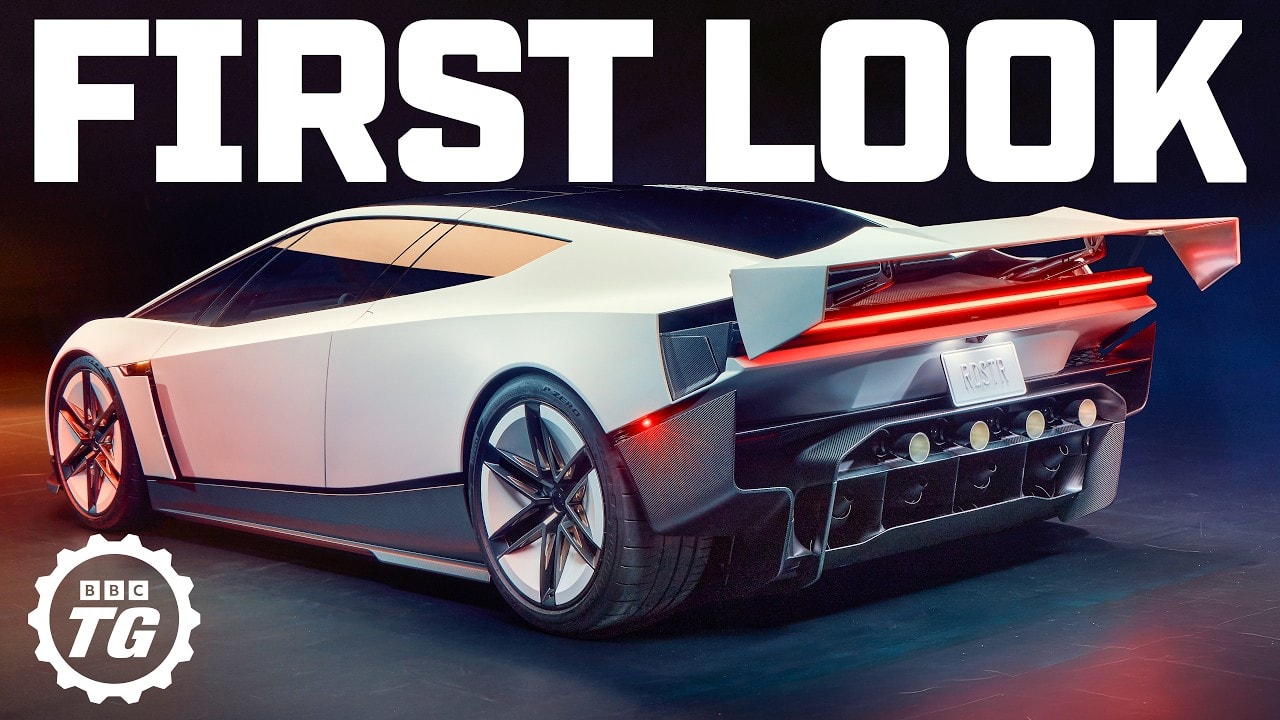
The new Tesla Roadster starts with a surprisingly sensible idea: build a lighter, rear-wheel-drive electric sports car that feels genuinely good to drive. Then someone adds suction fans, a pressure vessel borrowed from rocket thinking and enough cold-gas plumbing to make a heating engineer nervous.
At the top of the proposed range sits a single-seat version that Tesla says will hover. Subtle escalation, then.
The striking part is how little of that madness appears in the basic shape. This Roadster is a clean, angular wedge, quite different from the car revealed in 2017. Its most outrageous engineering hides beneath panels that move, unfold and retract when required.
During Top Gear’s exclusive first look, Tom Ford explored the car with Tesla chief designer Franz von Holzhausen and vehicle engineering vice president Lars Moravy. Their explanation reveals something more interesting than another acceleration boast: an attempt to combine a usable electric grand tourer with a thoroughly unreasonable performance experiment.
A qualification matters: the car presented is an alpha development vehicle described by Tesla as representing the intended production design. Performance figures remain claims or targets, some specifications changed after filming, and the base model’s figures are estimated or to be confirmed. Neither a 330mph run nor a hovering demonstration is established by this first look.
Why the Roadster Has Changed So Much
Nine years is a long time in car development, particularly when the rest of the company refuses to stand still.
Von Holzhausen explains that the previous Roadster design had begun to look like the future as imagined by an earlier Tesla. Cybertruck and Cybercab had since pushed the company towards simpler surfaces and a more distilled visual language. Merely finishing the old shape was no longer enough.
Engineering had moved on, too. Moravy says hardware originally developed around the earlier Roadster programme migrated into the Model S Plaid. Its three-motor arrangement, carbon-wrapped rotors, carbon-ceramic braking technology and track-focused development helped raise the performance of Tesla’s saloon.
That left the sports car with an awkward problem: it now had to clear a bar partly established by its own technology.

The answer is a bespoke chassis and a fresh brief. As Tesla pursues autonomous transport elsewhere, Moravy describes this programme as an effort to create an ultimate driver’s car. The proposed manufacturing location is Texas, with 2028 given during the discussion after an initial reference to 2027 is corrected.
That remains a production intention, not a delivered deadline. Roadster followers have earned the right to notice the distinction.
Two Motors, Rear-Wheel Drive and a Serious Weight Target
Forget the assumption that the new Roadster must have three or four motors. Tesla’s proposed layout puts two motors on the rear axle and none at the front.
Each rear motor has its own inverter and planetary reduction gearing, allowing the wheels to be controlled independently. That provides rear torque vectoring, which can help the car rotate into a corner or resist unwanted yaw. A brake-by-wire system adds another layer of stability control, including intervention at the front wheels.
The choice is partly about character. Tesla wants the sensation of the rear axle driving the car forward, rather than treating four-wheel traction as the automatic answer to every performance question.
Power is hardly being neglected. During the engineering discussion, Moravy describes high-output motors operating in roughly the 800 to 1,000-volt range, with cobalt-steel laminations helping achieve high power density. He discusses output beyond a megawatt and around 1,500 horsepower for the higher-performance hardware.
The later model breakdown gives an estimated standard-car output of one megawatt, approximately 1,340bhp, and roughly 960lb ft of torque. Those numbers should not be mistaken for a final, uniform specification across all four variants.
Why less than 1,700kg matters
Moravy’s preferred weight begins with “16”. In other words, he wants the lightest Roadster below 1,700kg.
His reasoning is refreshingly straightforward: power-to-weight matters, and a 2,200kg electric car cannot simply acquire the delicacy of a sports car through an enormous power figure.
The structure therefore mixes materials rather than relying on one fashionable solution. The alpha uses extensive carbon fibre, while the intended architecture combines carbon areas of the tub with aluminium components, glass and plastics where appropriate. Carbon-ceramic brakes are part of the package, and some body-panel decisions remain under development.
The car is still substantial. Its wheelbase measures 2,825mm, and Tesla quotes a width of about two metres. The wheel and tyre setup is staggered, with 20-inch fronts and 21-inch rears, wearing approximately 295/30 and 335/30 tyres respectively.
A Lotus-Inspired Wedge, With a Few Practical Tricks
The Roadster’s side profile has a distinctly mid-engined flavour, even though its battery lives under the floor. Ford spots a connection to the Lotus Esprit, and von Holzhausen confirms that the submarine Esprit kept in Tesla’s studio provided inspiration.
That influence makes sense in the long, low nose and stretched tail. The rear overhang is not merely decorative, either. It helps accommodate hardware that most sports-car designers do not have to package: a very large compressed-gas tank.
At the front, exceptionally slim headlight units preserve the uncluttered face. Tesla says they are thinner than the roughly 20mm-tall units used on Cybertruck, while still incorporating both low and high beams.
There is also a small naming dispute. The Roadster is not a conventional fully open roadster. Removable roof sections create a T-top arrangement, providing open-air motoring without a heavy powered folding-roof mechanism.
The doors are butterfly-style rather than conventional, drawing on the approach used for Cybercab. Along the sill sits an unusually thoughtful detail: a padded perch. An occupant can sit on it, rotate and slide into the low cockpit. Supercar access, briefly approached as an ergonomic problem rather than a flexibility test.
A Battery Built for Sustained Power, Not a Range Headline
The earlier Roadster promise included 620 miles, or 1,000km, of range. The new discussion settles around 310 to 320 miles, with battery capacity undisclosed.
That is a deliberate shift in priorities. Carrying enough battery for an enormous touring-range claim works against the effort to make a lighter, more responsive sports car.
Tesla instead describes a bespoke nickel-based lithium-ion chemistry developed for high power throughput. The cells are intended to deliver substantial power repeatedly, rather than provide one spectacular launch and then retreat into thermal self-preservation.
Cooling is central to that ambition. Moravy explains that the cylindrical cells receive cooling tubes on both sides, reducing the thermal disadvantage of extracting heat through only one side of a cell.
The same work should benefit charging. Tesla discusses charging power above 500kW using its newer Supercharger hardware. During the conversation, Moravy gives an ambition of roughly 15 to 85 percent in ten minutes; the later recap describes 15 to 80 percent in less than 15 minutes. These are development figures, not independently verified charging results.
Nor is this simply a case of attaching a Tesla Semi charging connector. Moravy distinguishes the truck’s megawatt-charging arrangement, which distributes power across a much larger battery, from the Roadster’s proposed system.
At this point, the recipe sounds almost restrained: useful range, fast charging, rear-wheel drive and less mass. Then the fans arrive.
Four Roadsters, Four Levels of Escalation
Tesla describes a range in which the extra systems build on one another:
- Roadster: the basic rear-wheel-drive sports car, with estimated specifications including around one megawatt of power and the lowest weight target.
- Performance: more torque, fan-generated ground effect, adaptive suspension and further chassis changes.
- Thrust: a two-seat configuration adding a 200-litre compressed-gas vessel and four rear thruster nozzles.
- Rocket: a limited-production single-seater with 600 litres of total gas storage, six additional nozzles and a claimed ability to hover.
This distinction is essential. The entry-level car is not being described as a flying machine, and its weight target should not casually be assigned to versions carrying considerably more equipment.
How the Fans Create Grip Before the Wings Can Help
An enormous motor output is only useful if the tyres can transmit it. Tesla’s response is to increase the force pressing those tyres against the road without simply making the car heavier.
The Performance model’s rear fans form part of an underbody suction system. Deployable side, front and rear skirts help define the space beneath the battery pack. Extracting air from that area lowers the pressure underneath, pulling the car towards the ground.
The advantage is greatest at low speed, where ordinary wings have relatively little airflow to work with. Rather than waiting for road speed to generate useful downforce, the fan system creates its own pressure difference.
There are echoes of the Chaparral fan car and McMurtry Spéirling, both raised during the discussion. Tesla’s proposed skirts are movable and compliant, allowing them to accommodate bumps and road humps rather than behaving like rigid blades against the surface.
The fans have a second job at speed
As speed increases, the front and rear skirts can lift, allowing more airflow beneath the car. The underfloor then operates as a Venturi-style passage, with the fans helping draw air through and out behind.
It is a dual-mode approach: suction for the low-speed gap, then assisted underbody airflow once the car is moving quickly enough for aerodynamic shaping to contribute more effectively.
Despite the excited language about defying physics, the principle is thoroughly physical. Tesla is trying to alter the available grip by changing the loads acting on the tyres.
The SpaceX-Inspired Thrusters Are Not Exhaust Pipes
The Thrust version goes beyond increasing tyre grip. It adds propulsion that does not depend on driving force passing through the tyres at all.
Its rear compartment contains a 200-litre composite overwrapped pressure vessel, or COPV, designed for pressures up to about 10,000psi. The system draws on SpaceX cold-gas technology.
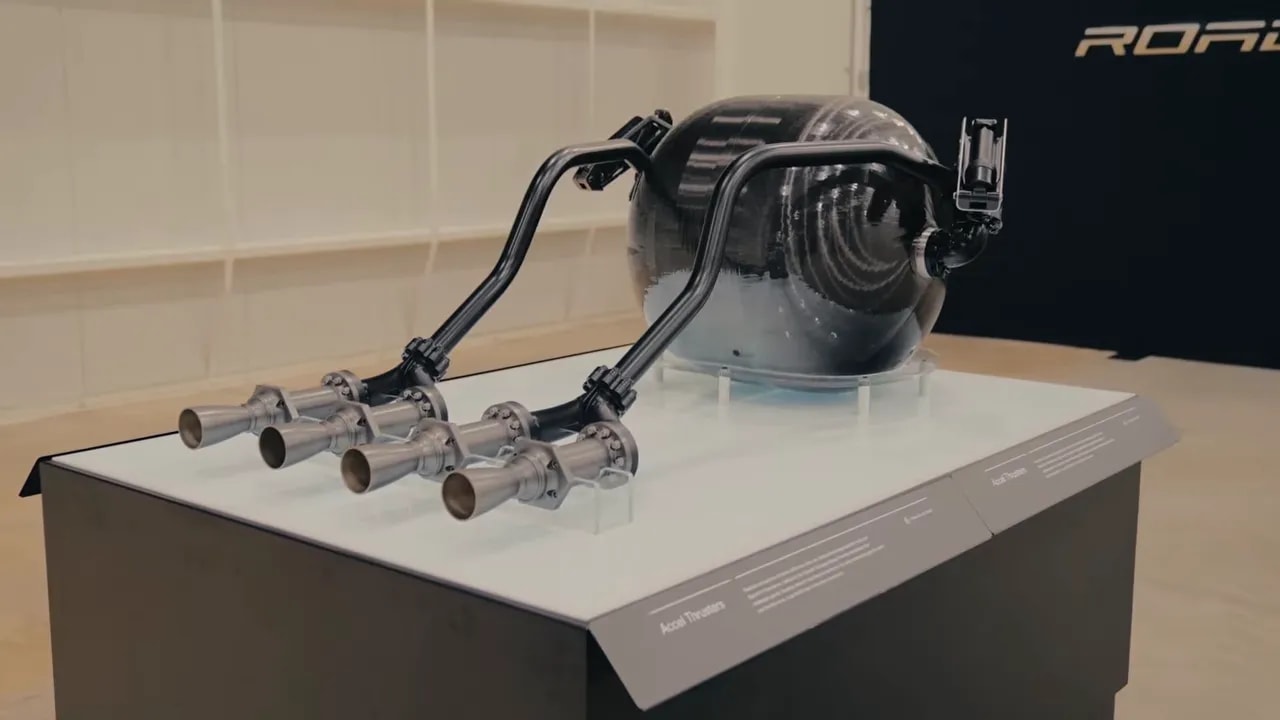
Although the conversation sometimes calls it compressed air, Tesla specifies filling it through a high-pressure nitrogen system. There is no fuel-burning afterburner. Stored gas is released through valves and equal-length pipes to four rear nozzles.
Small actuators borrowed from Tesla’s Optimus robot programme operate the valves. The nozzles can be controlled independently, allowing the system to correct unwanted yaw or help introduce rotation when required.
Moravy compares the intended thrust magnitude with that of a fighter jet. The practicality is rather less fighter-jet-like: the gas supply lasts about five seconds, enough for a single full deployment during a quarter-mile run.
Sub-one-second acceleration, with a catch
During filming, Tesla discusses approximately 0.85 to 0.88 seconds from 0 to 60mph for the Thrust system. Top Gear’s accompanying description subsequently raises the possibility of an even quicker figure, potentially below 0.59 seconds at the extreme end of the range.
Those are claims at different stages of development, not interchangeable tested results.
The catch is refilling. Tesla gives current filling times of roughly two to six hours, while aiming to reduce that to less than half an hour with a system still under development.
So the spectacular launch is not something to repeat at every traffic light. Even before the legal questions, the tank has other ideas.
Space, certification and road use
The gas vessel occupies space that would otherwise accommodate luggage. Positioned above the rear powertrain and alongside the surrounding suspension and battery packaging, it helps explain the Roadster’s extended tail.
Tesla says it intends to pursue crash certification and road homologation for the relevant production configuration. That does not mean activating thrusters on a public road will be permitted. The discussion explicitly separates driving the car on the road from using its gas-propulsion system there.
The Rocket version is described as being for off-road use only. Final certification and operating restrictions remain important unresolved details.
The Rocket Version Trades Its Passenger for More Gas
If 200 litres of high-pressure gas seems excessive, the Rocket version’s answer is another 400 litres.
The additional vessel replaces the passenger seat, turning the car into a single-seater with 600 litres of total storage. Six extra nozzles join the four at the rear: four positioned to generate upward thrust and two at the front for additional directional control.
Tesla says this arrangement will allow the car to hover. How high, for how long and under precisely what conditions are questions left unanswered in the first look.
That makes “flying car” an arresting description of the ambition, rather than evidence of a demonstrated capability. A brief vertical lift would also be a different proposition from sustained flight. The distinction does not make the proposal ordinary. It does keep the claim in focus.
Top speed carries a similar split between present discussion and future ambition. Moravy quotes 214mph for the current setup and says Tesla is working towards a 330mph version, with gearing identified as a key change and the aerodynamic design said to be capable of supporting the target.
A target, however, still needs a car, tyres and a successful run to turn it into a result.
Active Aerodynamics Without the Permanent Race-Car Costume
Von Holzhausen’s challenge was to hide all this capability inside a shape that remains recognisably clean. The result is bodywork that changes configuration rather than wearing every aerodynamic device permanently.
At the front, movable wing elements sit behind the chin spoiler. Tesla says they can rotate through as much as 80 degrees to manage airflow. Air passing through the front cooling system can exit upwards, while opening body sections help release pressure from the front wheel areas without requiring permanently conspicuous vents or door cutouts.
As speed rises into roughly the 40 to 60mph region, these aerodynamic surfaces become increasingly useful. The suction system handles the earlier part of the performance envelope.

The rear wing is particularly elaborate. In its low-drag position, it extends the tail’s aerodynamic profile. It can then change angle for greater downforce or act as an air brake during deceleration. Flow passes both over and beneath it through a biplane-like arrangement.
Its mechanism uses four-bar linkages and powerful actuators derived from Optimus ankle hardware. Robot ankles holding down a supercar wing: an unexpectedly specific piece of parts sharing.
The wing also hides the charging port. Opening it exposes the socket without requiring another visible flap in the bodywork.
With the panels retracted, the car returns to a relatively pure longtail shape. Deploy everything and it becomes much busier, but the underlying profile survives. Active ride-height control further changes its stance when the performance systems are in use.
Inside: Low Seats, Moving Pedals and a Steering Yoke
The cabin’s first surprise is space. Ford finds more headroom and shoulder room than the exterior suggests, helped by seating positioned very low over the single-stack floor battery.
Tesla has avoided heavy powered seat mechanisms. The seat structure sits low, the backrest adjusts through a manually operated pneumatic-style arrangement, and the pedals move to suit the driver’s leg length.
It is a racing-car solution with an everyday justification: most owners will find their position once and leave it there, so carrying seat motors everywhere offers limited benefit.

The yoke operates a steer-by-wire system rather than a conventional mechanical connection to the front wheels. Tesla describes approximately 170 degrees of movement in each direction, with variable steering response intended to avoid hand-over-hand inputs.
The exposed support structure is part of the design, not simply decorative machinery. Brake-by-wire accompanies the steering system.
That raises the obvious concern: does this become an elaborate simulator with number plates? Tesla’s answer is that the ordinary car must feel right first. Steering, braking and accelerator responses are intended to be linear and natural, with a comfortable grand-touring character before the extreme systems are added.
Ford is particularly interested in that basic version. A convincing electric sports car should not need hovering capability to make a good corner worthwhile.
Controls for the extraordinary, comforts for the ordinary
A boost control and DRS paddle provide access to performance functions and aerodynamic adjustment. Thrust requires a dedicated launch setup rather than an accidental prod of an everyday switch.
The touchscreen includes selectable driving modes and visualisations of the car’s systems. Aerodynamic deployment can be demonstrated manually in a show mode, but Tesla intends the car to manage the complex interactions automatically during driving.
A forward display area is intended to present relevant information such as speed, G-forces and lap timing. Narrow pillars and quarter-light windows help preserve forward and sideways visibility.
The chassis discussion also identifies front double-wishbone suspension, rocker-operated horizontal adaptive dampers, spool-valve technology and adjustable ride height.
And despite the fighter-pilot aspirations, there are heated seats and wireless phone charging. Apple CarPlay is absent. Apparently hovering is on the development list before that particular concession.
The Long Wait Still Belongs in the Story
The earlier Roadster pitch promised 0 to 60mph in 1.9 seconds before upgrades, 620 miles of range, a top speed beyond 250mph and production in 2020.
The history goes back further. Top Gear traces discussion of a Tesla-built successor to 2014, including the Model R name, before the Roadster appeared publicly in 2017 by emerging from the back of a Tesla Semi. Cold-gas thrusters entered the public promise in 2018.
Years of revised expectations followed. The new design may be substantially different, but that does not erase the wait experienced by people who placed deposits on the earlier proposition.
The important change is philosophical as much as visual. The new programme sacrifices the enormous range claim to pursue lower weight, sustained performance and a clearer driver-focused brief. Whether that trade delivers a better car will require more than a studio inspection.
The Original Tesla Roadster Shows Why the Basic Car Matters
For context, Ford returns to the original Roadster, Tesla’s first production car. Introduced in 2008, it used a modified Lotus Elise chassis with carbon-fibre body panels and weighed just over 1,300kg.
That remains an arrestingly modest figure beside modern electric performance cars.

Its Lotus ancestry is visible in the windscreen, roll hoop and proportions, although the wheelbase is about two inches longer than an Elise’s. Behind the cabin sits a 53kWh lithium-ion battery installation, arranged in an L-shaped package with control electronics above it and still some luggage space left over.
The car discussed produces 248bhp and 200lb ft, driving the rear wheels through a BorgWarner single-speed transmission. Its headline figures are:
- 0 to 60mph in less than four seconds.
- A top speed of approximately 125mph.
- About 244 miles of range, with later versions offering more.
Those numbers made the original Roadster much more than an electric novelty. Instant motor torque allowed it to embarrass contemporary petrol cars away from a standstill, while its range challenged the idea that battery power was useful only for short local journeys.
A sports car first, an important EV second
Its interior now feels like a small museum of recent technology: an Alpine stereo with a CD player, an iPod connection, physical ventilation controls and a tiny Tesla screen for charging, range and service information.
There are push-button drive selections, heated seats, a manual handbrake and unassisted steering. Getting in with the roof fitted is an exercise in commitment, but Ford finds the cabin comfortable once installed.
On the road, the steering is heavy at low speed. In corners, the extra battery mass makes the Roadster lean more than the lighter Elise, rather than changing direction with quite the same insect-like immediacy. Yet it still feels fundamentally like a sports car.
That is the part Ford considers significant. Electric cars have become vastly quicker since 2008, but natural sports-car feel remains a difficult target.
Top Gear places typical original Roadster asking prices at roughly £40,000 to £80,000 at the time of its assessment, depending on condition, with Signature Series examples and R80 battery-upgraded cars attracting particular interest.
Its broader importance is harder to price. The original Roadster helped establish lithium-ion battery propulsion as credible in a production sports car, combining meaningful range with genuine performance. Tesla’s later mass-market cars grew from that proof of concept.
A Veyron Moment, or Another Extraordinary Promise?
Tesla does not need the new Roadster to prove that an electric car can be quick. Its mainstream products settled that argument long ago.
The new car has a different purpose: explore how far the format can be pushed when the engineering team can combine battery development, independent motor control, fan downforce, active bodywork and SpaceX-derived gas systems.
Ford sees parallels with the Bugatti Veyron, a programme in which seemingly unreasonable executive demands forced engineers and designers into remarkable solutions.
The comparison captures the excitement, but the unfinished business matters. Production timing, final specifications, certification, repeated hard-driving performance, gas-refill practicality and the hovering claim all still need to become measurable realities.
For all the glorious excess of the Rocket, the most revealing test may belong to the least theatrical model. If Tesla can deliver a relatively light, rear-driven electric sports car with natural responses and sustained performance, the Roadster will have achieved something worthwhile before a single thruster opens.
Everything beyond that is the wonderfully unnecessary bit. Which, in this corner of the car world, is often where the most interesting engineering begins.
Original reporting: Tom Ford for Top Gear, with Franz von Holzhausen and Lars Moravy.
Adapted for readers by #teamHJB of ReelToRead.com — turning great videos into even better reads.

Be the first to comment