
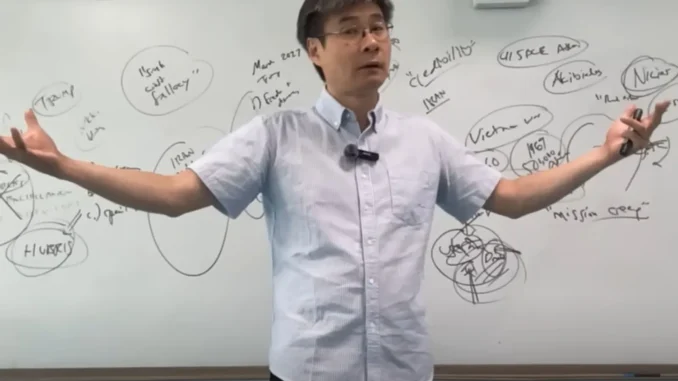

Credit: This article is based on ideas presented by Predictive History in its New York City Global Meet-Up lecture.
Why does the modern global economy keep producing war, debt, inequality, and social collapse? You can explain it through resources, military alliances, and power politics. But that explanation, I argue, does not go far enough.
The deeper issue is that capitalism is not merely an economic system. It is a worldview. It creates its own moral language, its own institutions, its own hierarchy of values, and eventually its own sacred mythology. Once you understand that, you can see why financial systems, ideological movements, war, technology, and religion keep colliding.
This is not a conventional account of geopolitics. It is an attempt to understand the hidden assumptions behind the modern order, including claims made in this lecture that should be approached critically and independently verified.
Key Takeaways
- Dollar-centered trade links energy markets, East Asian manufacturing, and Western financial consumption.
- Financialization concentrates wealth while increasing debt, inequality, and political dependence on powerful institutions.
- Global trade networks create efficiency but can become fragile when chokepoints, currencies, or energy supplies fail.
- Reclaiming attention, relationships, imagination, and humility is presented as a response to systemic instability.
Table of Contents
- The Global Economy Runs on Energy, Manufacturing, and the Dollar
- Financialization, Inequality, and the K-Shaped Economy
- Why Middle East Conflict Threatens the Entire System
- Capitalism as a Historical Accident
- The Contradictions Built Into Liberal Modernity
- Secret Societies, Networks, and the Need for Caution
- Eschatology and the Search for a Script of History
- War, Destruction, and the Logic of Rebuilding
- AI as the Latest Expression of Capital
- What Is Real Wealth?
- Education, Art, and the Courage to Be Wrong
- The Final Question: What Do You Do With a Dark Diagnosis?
The Global Economy Runs on Energy, Manufacturing, and the Dollar
Start with a simplified map of the global economy. You have the Gulf Cooperation Council countries supplying low-cost energy. That energy flows primarily toward East Asia, where it is turned into manufactured goods. Those goods then move to Western consumer economies.
At the center of this system sits the US dollar.
Energy is sold in dollars. Manufactured goods are sold in dollars. The dollars then flow back into American markets, real estate, Treasury securities, private equity, hedge funds, and other financial assets. This recycling process gives the United States a central role in the world economy, but it also creates deep structural problems.
The argument here is that reserve currency status does not simply create American power. It also forces America to serve the financial needs of the wider system.
Three Costs of Dollar Hegemony
First, the United States loses a measure of financial independence. Dollars circulate far beyond American borders through offshore markets often described as the Eurodollar system. Much of that money is created through bank credit rather than physical printing, making global dollar circulation difficult to measure or directly control.
Second, the system encourages financialization. Instead of making things, building factories, or investing in productive capacity, the economy increasingly shifts toward asset ownership, speculation, debt, and financial engineering.
Third, the United States becomes the guarantor of international trade routes. Global commerce depends on open seas, secure shipping lanes, and the predictable movement of goods. That requires military power, naval capacity, and a vast security architecture.
From this perspective, the United States does not maintain a huge military primarily because it faces an imminent invasion. It maintains a huge military because the global trading system depends on it.
The lecture frames this as a bad bargain for ordinary people. Money that could support healthcare, education, public infrastructure, or local communities instead sustains a global system whose greatest beneficiaries are financial institutions, defense contractors, and politically connected elites.
Financialization, Inequality, and the K-Shaped Economy
When capital earns more from financial assets than from productive work, wealth tends to consolidate. A factory might produce modest returns over time, while financial assets can generate larger returns for those who already own them. This dynamic resembles themes discussed by economist Thomas Piketty in Capital in the Twenty-First Century.
The result is a society divided into two paths:
- Asset owners benefit from rising markets, property values, and financial returns.
- Workers face stagnant wages, rising housing costs, debt, and declining security.
That is what is meant by a K-shaped economy. One side rises sharply while the other falls behind.
The 2008 financial crisis is presented as the clearest symbol of this problem. When financial institutions were rescued while many homeowners were left exposed, the system signaled whose interests mattered most. The lesson was not merely economic. It was political: institutions close to power could receive protection, while ordinary people carried the losses.
This is why corruption, inequality, and debt are treated as structural symptoms rather than isolated failures. They are not glitches. They are what happens when a society is organized around the endless expansion of financial claims.
Why Middle East Conflict Threatens the Entire System
The lecture then turns to the Middle East and argues that a major regional conflict can disrupt the foundations of global trade.
The crucial point is geography. Energy shipments move through narrow maritime chokepoints. If major routes are blocked, threatened, or militarized, the economic consequences extend far beyond the region itself. Disruption affects oil, shipping insurance, food prices, manufacturing supply chains, currencies, and global liquidity.
The argument identifies several pressure points:
- The Strait of Hormuz, a critical route for Gulf energy exports.
- The Bab el-Mandeb, linking the Red Sea to the Gulf of Aden.
- Regional conflicts involving Iran, Israel, Hezbollah, the Houthis, Iraq, Saudi Arabia, and other actors.
- Russian and Chinese logistical links that could connect Middle Eastern conflict to wider Eurasian tensions.
In this framework, pipelines do not solve the underlying problem. Pipelines may reduce reliance on shipping routes, but they are expensive, vulnerable, and slow to construct. If drones and missiles can threaten ships, they can also threaten fixed infrastructure.
The larger claim is that a regional conflict could become a global liquidity crisis. Japan, China, and Gulf states have historically played major roles in recycling dollar liquidity through Treasury markets and other investments. If these economies become more defensive, nationalistic, or preoccupied with energy security, that money may no longer flow outward as freely.
The Japanese Yen Carry Trade as a Fragile Support System
Japan is used as an example of how global finance can become detached from productive investment. In a yen carry trade, investors borrow cheaply in yen and invest in higher-yielding assets elsewhere, including US securities.
The lecture argues that this arrangement has supplied global liquidity at enormous scale. But it also makes the system vulnerable. If the yen weakens sharply, if Japan faces an energy shock, or if Japanese institutions need to bring money home, global markets can suddenly lose an important source of funding.
That is the fragility at the core of the argument: the world economy appears interconnected and efficient, yet the same interconnection can make it brittle. One blockage, one currency panic, or one energy shock can trigger cascading consequences.
Capitalism as a Historical Accident
Capitalism is often presented as the natural end point of human progress. This lecture argues the opposite. It describes capitalism as the outcome of several historical accidents that eventually hardened into institutions and ideology.
Calvinism and the Discipline of Saving
The first turning point is Calvinism, especially the doctrine of predestination. If salvation has already been determined by God, how do you know whether you are among the chosen?
One answer, historically associated with Protestant work ethic arguments, was visible worldly success. Wealth could become a sign of divine favor. But wealth was not supposed to be spent recklessly. It was to be saved, reinvested, and expanded.
That produces a radically different relationship to money. Instead of turning wealth into communal status, feasting, generosity, or family prestige, you accumulate it. You invest it. You make capital reproduce itself.
The Dutch Republic becomes central in this story because it helped develop institutions that pooled savings into commercial enterprise, colonial trade, and global monopolies.
The Glorious Revolution and the Bank of England
The next turning point is the Glorious Revolution of 1688, followed by the founding of the Bank of England in 1694.
The essential innovation was not simply banking. It was the idea that lenders could finance a national political system rather than a single monarch. Kings could die, lose wars, or refuse to repay debts. A state backed by Parliament and taxation offered a more durable borrower.
This created a system in which public authority could support private finance. Credit became tied to the future labor and taxable capacity of a whole nation.
That model made long wars easier to finance. The British state could sustain military competition against France and Napoleon not merely through battlefield strength, but through access to credit, debt, and financial institutions.
The argument is that modern capitalism grew from this marriage of private capital, public guarantees, empire, and war finance.
The Contradictions Built Into Liberal Modernity
Once capitalism became dominant, it needed a philosophy that could make its contradictions feel natural.
The first contradiction is between democracy and private property. Democracy implies popular rule. Private property places limits on what the public can collectively decide. If a majority wants redistribution, but wealth is treated as inviolable, then the two principles are already in tension.
The second contradiction is between reason and emotion.
Modernity often treats reason as objective and emotion as irrational. But the lecture gives this distinction a political meaning. “Reason” becomes associated with capital, mobility, markets, and efficiency. “Emotion” becomes associated with family, religion, tradition, community, nationality, and attachment to place.
Anything that slows the free movement of money, goods, people, or ideas can then be dismissed as prejudice, backwardness, or irrationality.
Whether you accept that interpretation or not, it asks a serious question: who gets to define reason, and whose values become obstacles when markets demand greater mobility?
Secret Societies, Networks, and the Need for Caution
The lecture makes sweeping claims about Freemasonry, secret societies, transnational networks, religious movements, and elite coordination. These claims are presented as a theory of how power operates across borders.
The central mechanism is described through three concepts:
- Information: gaining knowledge faster than others.
- Infiltration: placing trusted people inside important institutions.
- Coordination: acting across borders and institutions toward shared interests.
The Rothschilds and the Battle of Waterloo are used as an illustration of the advantages created by faster information networks. But historical anecdotes about financial families, secret organizations, and religious groups are often surrounded by misinformation and conspiracy narratives. You should distinguish documented institutional power from broad claims of hidden ethnic or religious control.
Powerful networks do exist. Business networks, political alliances, lobbying groups, intelligence services, religious institutions, universities, and social circles can all create unequal access to information and opportunity. That does not make every claim of a unified secret hierarchy true.
When examining these questions, insist on evidence, avoid collective blame, and resist narratives that reduce complex historical processes to a single hidden group.
Eschatology and the Search for a Script of History
The lecture’s central idea is that some political and religious movements understand history through eschatology, meaning beliefs about ultimate destiny, final judgment, cosmic struggle, redemption, or the end of an age.
According to this model, movements driven by a sacred end goal can be unusually durable because they have three advantages:
- They can operate across generations because they follow a long script.
- They can recruit widely because people can participate in a shared cosmic purpose.
- They can inspire intense sacrifice because the mission is framed as larger than individual comfort.
This is presented as an explanation for why movements organized around transcendent meaning can outlast movements built only around money, charisma, or personal ambition.
However, the leap from theological beliefs to claims that entire populations or institutions seek catastrophe must be treated carefully. Religious traditions are diverse. Jewish, Christian, Muslim, secular, and political communities contain many internal disagreements, interpretations, and moral positions.
You should never confuse extremist interpretations with the beliefs of an entire faith or people.
War, Destruction, and the Logic of Rebuilding
The lecture makes a disturbing claim about capitalism: it does not merely create wealth. It also needs to destroy wealth.
The reasoning is that accumulated prosperity can reduce the pressure to work, invest, and compete. If capital cannot find profitable opportunities in mature economies, it seeks new frontiers. War, crisis, debt, privatization, and reconstruction can create those opportunities.
The metaphor is blunt. If infrastructure is old and expensive to renovate, destruction may appear to some investors as a faster path toward rebuilding. The point is not that every crisis is secretly planned. The point is that powerful actors can benefit from destruction even when they did not directly cause it.
This is why postwar reconstruction, disaster capitalism, and privatization deserve scrutiny. When public systems fail, someone often arrives with financing, contracts, land purchases, and a plan for rebuilding.
The lecture imagines capital moving away from exhausted centers such as the United States and China toward zones of future reconstruction and geopolitical transformation. Whether or not you accept the forecast, the question remains: who benefits when a society is destabilized, and who gets to own the reconstruction?
AI as the Latest Expression of Capital
Artificial intelligence is framed here not as a separate technological revolution but as the logical continuation of a system that values frictionless coordination.
In this account, AI promises to accelerate the movement of information, automate decision-making, and reduce the unpredictability of human emotion. It turns attention, behavior, and data into resources that can be measured and managed.
That makes AI powerful, but also dependent on physical systems: energy, water, chips, rare earth minerals, supply chains, data centers, and finance. If global trade fragments, the material foundation of AI becomes more vulnerable.
The lecture also warns that AI investment may be concentrated in a small number of interdependent firms. If those firms rely on circular financing, rising valuations, and expectations of government support, then a future crash could shift losses onto the public while preserving private control.
You do not need to accept the prediction of an inevitable AI collapse to recognize the underlying concern: technological systems should not become so concentrated that society must rescue them regardless of the cost.
What Is Real Wealth?
The lecture eventually returns to the individual level. Real wealth, it argues, is not primarily money. It is your attention, imagination, relationships, and capacity to create meaning.
Platforms often feel free because you are not paying in cash. But you are paying with attention. Your focus becomes the commodity.
The response is not simply to withdraw from the world. It is to reclaim your attention and put it where it has human value:
- Read deeply and regularly.
- Know your neighbors.
- Build relationships that are not transactional.
- Practice generosity and care.
- Develop your imagination instead of outsourcing it to systems designed to capture it.
The discussion of family follows the same principle. You cannot solve every uncertainty through a cost-benefit calculation. Meaningful commitments demand faith, responsibility, and a willingness to act before conditions feel perfect.
Education, Art, and the Courage to Be Wrong
Education, in this view, should not merely prepare you for material competition. It should teach you how to ask serious questions about meaning, history, power, imagination, and moral responsibility.
The recommended path includes reading works that deepen your emotional and moral intelligence, including Homer, Dante, Tolstoy, Dostoevsky, and Raymond Carver. The aim is not to memorize a canon. It is to recover the habit of sustained attention.
For teachers, the most powerful sentence may be: I am wrong.
That sentence models humility, reflection, and the possibility of growth. If you can admit error, you give others permission to learn without shame. In a culture built around performance and certainty, that is a profound act.
Art also has a role. The artist is not merely an entertainer or lifestyle brand. The artist can become a truth-teller, someone who reveals hidden possibilities and helps people imagine a different world.
The Final Question: What Do You Do With a Dark Diagnosis?
The lecture’s diagnosis is bleak. It predicts intensifying conflict, financial instability, disruption of supply chains, social fragmentation, and an accelerating pace of change.
But its final message is not despair. It is that crisis can force you to confront questions that comfort allowed you to avoid: Who are you? What do you value? What are you willing to serve? What kind of life do you want to build with others?
You do not have to accept every claim in order to take those questions seriously. In fact, the responsibility is to question all of it. Examine evidence. Reject collective blame. Be wary of apocalyptic certainty. Pay attention to the material realities of power, war, finance, and technology without surrendering your ability to think independently.
What matters most is that you do not hand over your attention, your conscience, or your imagination to people who promise to explain everything for you.

Be the first to comment