
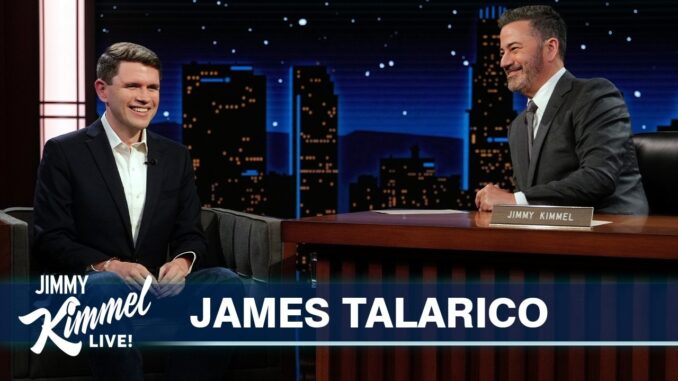

Source credit: This interview was originally published by the Jimmy Kimmel Live YouTube channel.
Jimmy Kimmel opened the conversation with an unusual bit of context: he said the FCC had targeted the show, its network, and local ABC stations over interviews with political candidates. Late night shows have hosted candidates for years, including Donald Trump on this show twice when he was running. But rather than allow political pressure to decide who gets interviewed, this conversation with Texas Democratic Senate candidate James Talarico was released online.
And it quickly became something more than a standard campaign stop. There were jokes about Talarico looking like Richie Cunningham or a student council candidate, sure. But there was also a serious argument about faith, public policy, corporate power, political accountability, and the right to vote.
Key Takeaways
- Talarico frames his Senate campaign as a multiracial, cross party movement for working Texans.
- He argues Christian faith requires concrete care for hungry, sick, immigrant, and marginalized neighbors.
- His campaign rejects corporate PAC money and contrasts grassroots donations with billionaire political influence.
- He urges Texans to verify registration and vote early amid polling location closures and suspended registrations.
An Underdog Campaign Taking on Texas Power
Talarico described himself as the underdog in a very red state, at least until every vote is counted. But he argued that the race is bigger than one candidate against one opponent. In his telling, it is a fight against a political system built to serve the powerful people at the top.
He pointed to what he characterized as major spending against his campaign, including millions from Elon Musk and $10 million from MAGA Inc. in a single week. The point was not that he expects an easy win. The point was that a coalition of working people can scare a system accustomed to calling all the shots.
His campaign message is built around people coming together across party, race, gender, religion, and culture. The common enemy, he said, is not the neighbor with a different voting history. It is the corrupt arrangement that has left working people carrying the burden while the well connected keep collecting.
Faith Is Not a License to Ignore Your Neighbor
One of the most forceful portions of the interview concerned Talarico’s Christian faith and his belief that Jesus has been politically co opted in ways that contradict the teachings of the Bible.
Kimmel raised a straightforward question: Would Jesus approve of separating families, taking food assistance from children, or treating vulnerable people as disposable? Talarico’s answer was that faith cannot be reduced to a private relationship with God while neglecting or abusing the people around us.
He described a theology of neighborly obligation:
- You cannot claim love for God while hating other people.
- You cannot claim love for God while abusing immigrants.
- You cannot claim love for God while oppressing poor people.
- You cannot claim love for God while bullying people pushed to the margins.
For Talarico, the divine image is not some vague abstraction. It is present in the person sitting next to you. It is present in the neighbor whose life becomes harder when food aid is cut, health coverage disappears, or family members are targeted for deportation.
He specifically invoked Matthew 25, where care for the hungry, sick, and stranger is central to how people are judged. He imagined Jesus arriving in the Senate and confronting lawmakers who cut food assistance, remove people from Medicaid, and deport families. Then, naturally, Jesus would flip over some fancy Senate desks.
Why It Is Time to Start Flipping Tables
Talarico’s campaign slogan, “It’s time to start flipping tables,” refers to Jesus overturning the tables of money changers in the temple. It is not presented as a call to chaos. It is a call to stop mistaking politeness for moral courage when people are being hurt.
The version of Jesus who is gentle and compassionate is real, Talarico said. But so is the Jesus who walked into the seat of power and disrupted an unjust arrangement when his neighbors were being harmed. He framed that act as civil disobedience on behalf of people who needed protection.
That is the campaign’s moral through line: public policy should be one way of loving your neighbor. If politics cannot make people’s lives easier, safer, healthier, and less stressful, then all the chest pounding in the world is just professional wrestling with worse lighting.
Who Really Gets the Handouts?
Kimmel noted that debates about food assistance and social programs often come wrapped in the assumption that recipients simply do not want to work. Talarico said that framing obscures a much larger problem.
During a conversation with undecided Texas voters, someone raised the old “welfare queens” line. Talarico responded by arguing that the country’s most significant beneficiaries of public favoritism are giant corporations that pay no corporate taxes and wealthy executives who write off private jet travel.
Whether the issue is tax treatment, corporate PAC money, or access to power, his argument is that public anger should be directed toward those extracting the most while contributing the least.
He contrasted that with his own campaign funding, saying he does not accept money from corporate PACs and that his contributions come from Texans giving $5, $10, or $15 at a time. He described the campaign as a people powered movement, not a billionaire backed project.
Two Events, Two Very Different Ideas of Politics
While the Republican National Committee gathered in Dallas, Talarico contrasted the event with an effort by his campaign to collect groceries for Texas families. He noted that tickets to the convention gathering cost $20,000, while campaign volunteers collected 20,000 pounds of groceries for working Texans.
That contrast is the whole pitch in miniature. One side, he argued, is built around powerful donors gathering in a convention center. The other is about people organizing around the needs of families who are struggling to afford the basics.
Yes, political campaigns require fundraising. Kimmel correctly pointed out that raising money has become one of the central jobs of modern candidates. But Talarico’s point was that where the money comes from matters just as much as how much of it there is.
Political Smears, Nicknames, and the Things They Do Not Fix
The interview took a comic turn when Kimmel recounted attacks on Talarico involving his veganism, sexuality, gender politics, and Christianity. Talarico suggested that people are exhausted by politics as performance, especially when the performance does nothing for everyday life.
Nicknames do not lower grocery prices. They do not lower gas prices. They do not lower health care costs. They do not help a family get through the month.
Donald Trump had recently called Talarico a “freaky guy” and repeatedly mispronounced his name. Talarico’s response was quick: the campaign had begun selling “I’m a Talarico” shirts, and the accidental nickname had become one of the site’s fastest selling items.
Then he turned serious again. Talarico said he is not suddenly discovering religion for campaign purposes. His grandfather was a Baptist preacher in South Texas, he still attends the church where he was baptized as a toddler, and he is studying to become a minister.
His answer to accusations that he disrespects Jesus was blunt. In his view, what disrespects Jesus is kicking sick people off health care in order to fund tax cuts for billionaires, or sending Americans into another forever war while innocent children are harmed.
The Ken Paxton Pen Story Becomes a Campaign Message
There is no smooth transition from biblical justice to an allegedly stolen pen, which is why politics is truly the greatest comedy writer alive.
Kimmel asked Talarico about a security video involving Texas Attorney General Ken Paxton and a fellow attorney’s $1,000 pen. Talarico said the pen had been a gift from the attorney’s wife and was left in a bin at courthouse metal detectors. According to Talarico’s account, security footage identified Paxton as the person who took it, and the pen was not returned until police became involved.
That allegation became the punch line in a campaign video featuring the pen’s owner: Talarico will not steal your pen.
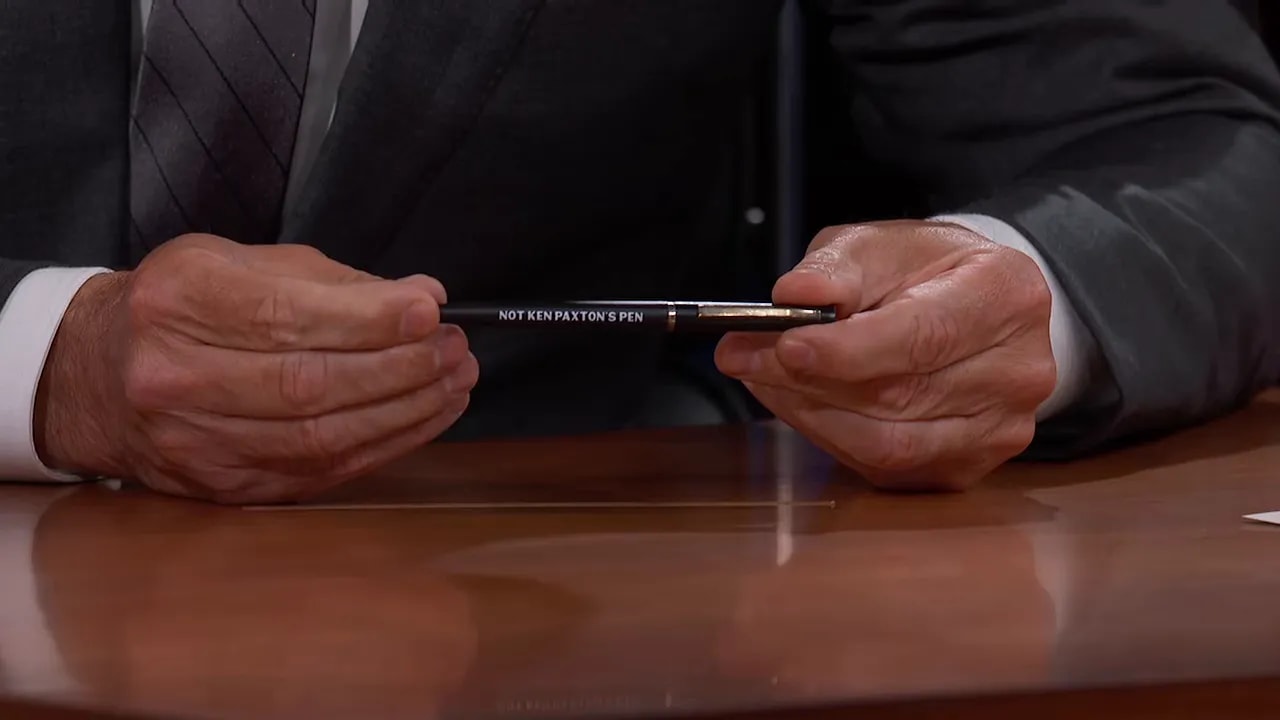
The joke lands because it is attached to a broader argument. Talarico repeatedly called Paxton the most corrupt politician in Texas and criticized what he described as a political class that uses public office to enrich itself and donors.
He cited figures about Paxton’s wealth that he said were alarming: a 7,000 percent increase in net worth while earning a $150,000 government salary, and ownership of 15 homes while many Texans cannot afford one. Those are campaign claims advanced during the interview, and Talarico’s larger complaint was clear: elected officials should not be getting rich while ordinary wages remain stagnant.
Public Officials Should Answer Hard Questions
Talarico also criticized Paxton for declining debate invitations after accepting them, then failing to schedule one. He said candidates and public officials should answer difficult questions, especially questions about wealth, public trust, and potential corruption.
His standard was simple: when people ask him tough questions on the campaign trail, he answers. That is not a favor from an officeholder. It is part of the basic deal in a democracy.
Kimmel also referenced the political turmoil around Paxton, including reports that his staff took concerns to the FBI, that Texas House Republicans impeached him, and that one of his former defense attorneys has endorsed Talarico. The conversation treated these as evidence of a Republican establishment that has already seen enough.
Ted Cruz, Ken Paxton, and a Texas Emergency
Trump’s comments about Paxton created another opening for Kimmel. He noted that Trump helped clear the way for Paxton politically, only to later criticize Paxton’s appearance, clothes, and manner of speaking. Talarico joked that if Trump wanted to be on the winning side, he was welcome to join the campaign.
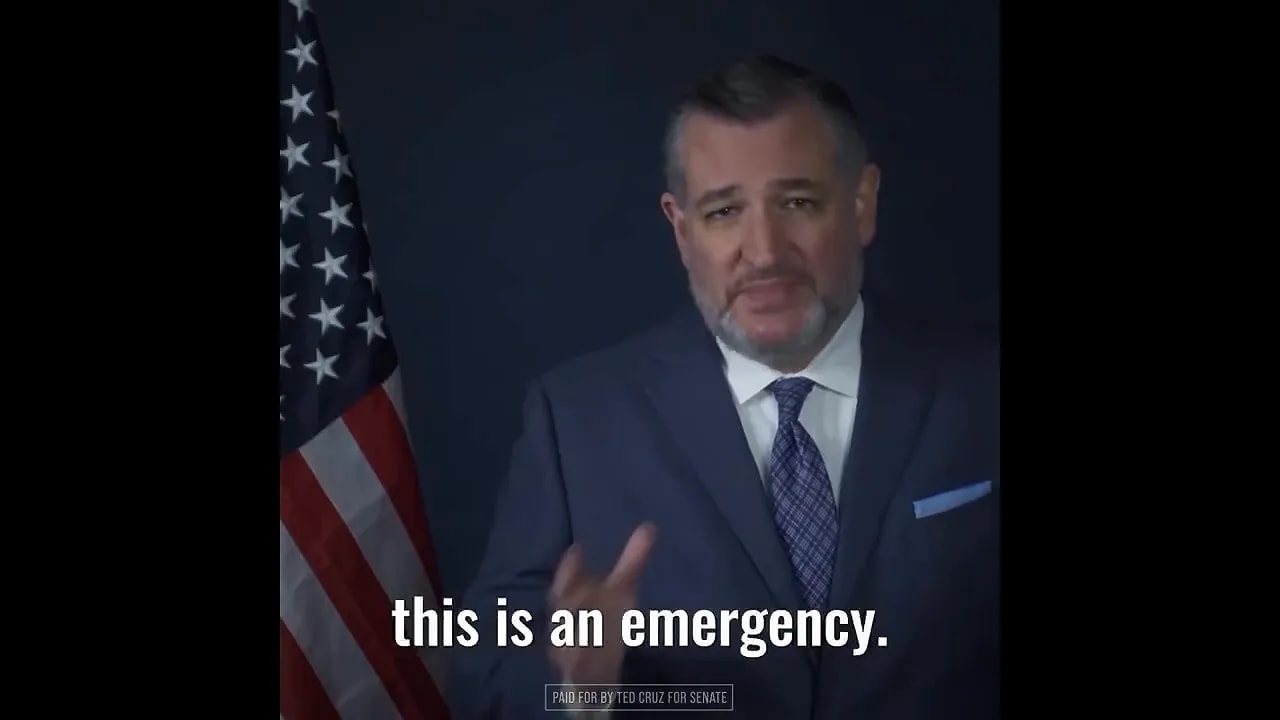
The interview also played a clip of Ted Cruz calling the prospect of losing Texas an emergency. Talarico answered with another Texas sized joke, saying Cruz may have filmed it from Cancun.
Paxton also caught some grief for reportedly spending the Fourth of July in London, while Talarico said he was in Austin at Willie Nelson’s annual Fourth of July picnic. The contrast, as they say, could not be more Texas.
Voting Access Is the Serious Part
The final issue was far more consequential than nicknames, pens, or vacation jokes. Kimmel raised the closure of voting locations in Tarrant County, home to Fort Worth and described in the discussion as the state’s largest swing county.
Talarico said 92 polling locations were being closed, about one third of all polling sites in the county. Officials had cited funding, but he called the rationale ridiculous and argued that the effect would be to make voting more difficult.
He also said that one million voter registrations had been suspended in Texas. His advice for Texans was practical:
- Check voter registration status online.
- Make a plan to vote early.
- Do not assume a registration is active simply because it was active before.
For Talarico, voting access is not a side issue. The right to make one’s voice heard and shape one’s own future is among the most American rights there is. Attempts to limit access may be powerful, he said, but they are not stronger than people acting together.
The Central Case: Love Your Neighbor Through Public Policy
The conversation moved from faith to food assistance, corporate money, campaign attacks, corruption allegations, voting access, and a suspiciously expensive pen. Yet the same idea connected all of it.
Politics should be about making a neighbor’s life better. Not making a donor richer. Not inventing a nickname. Not winning cable news points. Not finding new ways to make voting harder.
That is why Talarico’s message is less about being a perfect candidate than about refusing to accept a political system that expects the public to settle for less. If the tables are rigged, maybe it really is time to start flipping them.
Full credit goes to the Jimmy Kimmel Live YouTube channel for the original interview.


Be the first to comment