
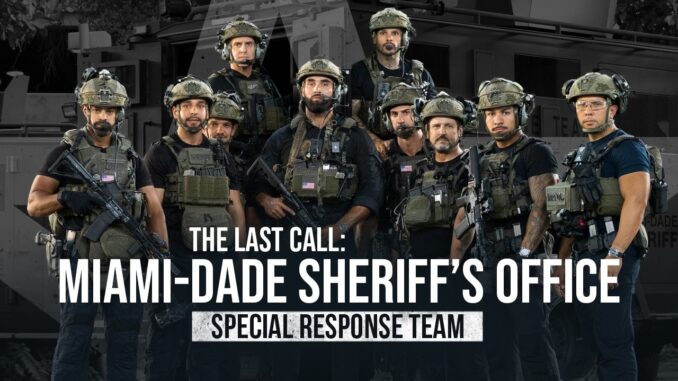

A call can begin with a plan that has been worked out in advance or with a warrant that has just come in. Either way, the team needs to understand the assignment, know where everyone belongs and be ready for the situation to change.
That is the work of a full-time Special Response Team within the Miami-Dade Sheriff’s Office. We respond to high-risk incidents across the county, including search warrants, barricaded subjects, hostage rescues and active shooters. Some team members are sniper certified and provide overwatch at major events. The team also handles dignitary protection.
We have more specialized training and equipment than an average officer. That does not make us better people. It means we have a responsibility to be prepared for the calls that require those capabilities.
Building the team takes more than physical strength
Selection is rigorous, and the physical portion eliminates a lot of candidates. But fitness alone does not tell us who we want beside us on a difficult call. We look at how someone works with others, responds to adversity and solves problems when the easy answer is gone.
We want people who are hungry to learn and willing to work. That attitude carries into everything we do. We push each other during workouts, on the range and in the shoot house. We compete, too. It can be good-natured and intense at the same time, because everyone wants the person next to them to get better.

Training creates room to think
In a fast-moving situation, there may be very little time to make a decision. We train on problems repeatedly so that, when something familiar happens in the field, we can recognize it sooner. Repetition does not remove the need to think. It gives us a better chance to think clearly when everything around us is speeding up.
That is the value of practicing under pressure. The goal is to find some calm inside the chaos, work through what is happening and make the best decision we can. Preparedness matters most when the situation does not unfold exactly as expected.

Trust has to be earned
Our work depends on trust in a very literal sense. If a teammate tells me an area is clear, I need to know they did the work behind those words. They need to be able to count on me with the same confidence. A mistake can put other people in danger, so nobody gets to treat that responsibility lightly.
We talk about brotherhood, but saying it is not enough. Trust grows over time, through training, through hard calls and through seeing how someone responds when others need help. Shared danger builds a bond, but so does consistently doing your job well.
The sacrifice does not end with the shift
Being assigned to a SWAT team can make it hard to feel completely off duty. Calls take us away from home, sometimes when our families expected us to be there. A child might understand that Dad has an important job and still wonder why he has to leave at night or miss a promised bedtime story.
That time cannot be given back. We try to be present when we are home, while being honest about the fact that people may need us to leave. The responsibility to our families and the responsibility to the community both matter.

We are also reminded that the risk is real. At a Miami-Dade law enforcement officers memorial ceremony, a widow speaks about once admiring her husband in uniform and now honoring him after his death. It is a painful reminder of what families can lose.
When the call comes
Search warrants are often planned ahead. Sometimes one arrives with little notice. As we prepare to respond, we have to consider the possibility that a person may be armed or determined not to surrender. We cannot know exactly how they will react.
That uncertainty is why the planning, training and trust matter. Every team member has a role. We need to communicate, get into position, identify ourselves and carry out the warrant while responding to the reality in front of us. No amount of practice makes a dangerous call routine, but practice helps us meet it together.
Why we keep answering
For me, this work has been a goal since middle school. I grew up in Miami and saw a series about the Miami-Dade SWAT unit. I kept coming back to it, thinking that one day I wanted to be part of that team.
Now the people beside me feel like family. We work hard because none of us wants to let the others down, and because the work matters to the county we serve. Miami is home. Helping keep its people safe is why I wanted this job, and it is why I will keep showing up when the call comes.
Full credit for The Last Call: Miami-Dade Sheriff’s Office Special Response Team goes to Staccato 2011®, the storyteller and production partner behind The Last Call series.

Be the first to comment