
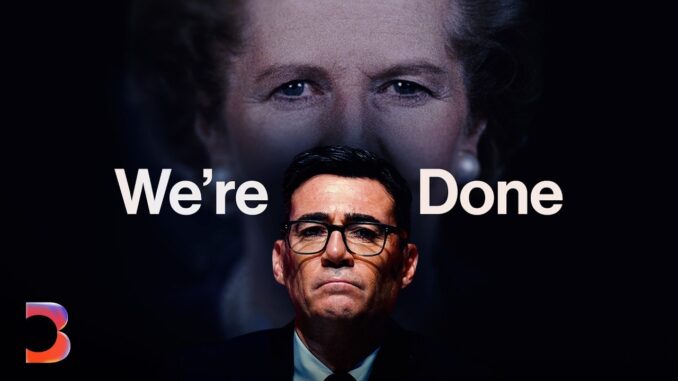

Original reporting and analysis: Bloomberg Originals. This article adapts its examination of Margaret Thatcher’s economic legacy, Andy Burnham’s proposed alternative, and the financial constraints on remaking Britain.
Few British leaders divide opinion quite like Margaret Thatcher. To her admirers, she rescued a country that had become almost ungovernable. To her critics, she dismantled industrial communities and handed too much power to private capital. Both sides agree on one thing: she changed Britain profoundly.
Between 1979 and 1990, Thatcher weakened trade unions, privatized state-owned businesses and helped shift the economy toward the City of London. Much of the system she built survived her departure from Downing Street.
Andy Burnham’s challenge is to break with that settlement. His alternative promises more local power, greater public control of essential services and a more active industrial state. But political ambition meets an unforgiving financial reality: weak growth, expensive borrowing and mounting demands on public services.
The question is not simply whether Britain wants to move beyond Thatcherism. It is what replacing it would mean, and whether the country can afford the transition.
Why Thatcherism Began
To understand the appeal of dismantling Thatcher’s model, it helps to remember why it emerged.
Britain in the 1970s was struggling with high inflation, powerful trade unions and a pervasive sense of decline. Its request for an International Monetary Fund bailout reinforced the impression that the country could no longer manage its own economic affairs.
Industrial conflict was not a marginal problem. In 1979, almost 30 million working days were lost to disputes, the highest total since the general strike of 1926. Successive governments appeared unable to bring the situation under control.
Thatcher’s diagnosis was that Britain had become too dependent on organized labor and on the idea of government as an all-purpose provider. Her answer was not a modest adjustment. It was an economic overhaul.
There is an intriguing parallel with Burnham’s argument. Where Thatcher saw a country beholden to unions, Burnham sees one excessively constrained by bond markets. Each identifies a powerful force limiting what government can do. But their preferred remedies point in very different directions.
What Thatcherism Changed
Thatcherism combined several policies that together reshaped the relationship between the state, businesses and workers:
- Monetarism: an attempt to bring inflation down by controlling the money supply.
- Lower top tax rates: a shift toward greater rewards for private earnings and enterprise.
- Weaker trade unions: a lasting reduction in organized labor’s influence.
- Stronger central government: more power in Westminster and less autonomy for local decision-makers.
- Privatization: the transfer of extensive state-owned businesses into private ownership.
The upheaval came with substantial social costs. Unemployment reached about 11%, leaving roughly three million people out of work. Anger over the government’s policies spread well beyond the unions directly confronting it.
The consequences were also geographically uneven. As a broad generalization, southeast England fared better than areas undergoing rapid deindustrialization. Northern manufacturing communities lost major employers, while businesses on their high streets suffered alongside them.
Meanwhile, finance gained influence. Britain’s economy moved away from industrial production and toward the City, where companies increasingly operated as global businesses. That regional divide remains central to the argument over Thatcher’s legacy.
Privatization: A Nation of Shareholders, Then a Backlash
When Thatcher took office, nationalized industries accounted for as much as 10% of the British economy and employed almost two million people. The wider public sector employed 7.9 million.
Privatization was therefore more than a change in management. It was a major redistribution of economic ownership.
Businesses such as BT and British Gas, along with electricity networks, became emblematic of the program. In utilities, this often meant privatizing monopolies rather than introducing straightforward competition between numerous suppliers.
The political sales pitch was powerful: ordinary households could become small-scale capitalists. Buying shares would give people a stake in the economy and, perhaps, a portfolio to pass on to their children. British Gas’s famous campaign, built around spreading the news to a character named Sid, brought that idea into everyday life.
Initially, privatization delivered tangible benefits. Asset sales raised substantial sums for the Treasury, and private money flowed into services that had become run down. Most of the businesses sold remained private, while trade unions never recovered their former powers.
But the bargain became harder to defend as customers faced higher bills and investment failed to keep pace with requirements. The contrast between expensive services and well-paid utility executives intensified public frustration.
Water has become the clearest symbol of that backlash. Sewage discharges into rivers and coastal waters raise a basic question: if private ownership is supposed to improve performance, why are essential networks still falling short?
For Burnham, water represents a broader failure in the way Britain organizes public necessities. It is also where the practical difficulty of reversing privatization becomes most obvious.
Britain’s Borrowing Costs Leave Little Room for Experiment
Thatcher’s successors face a different economic constraint. Inflation and industrial disputes defined much of the crisis she inherited. Today, debt and the cost of financing it limit the government’s choices.
Bloomberg’s analysis describes a rise in borrowing costs that has halved Labour’s fiscal headroom. That headroom is the financial cushion available before the government risks breaching its fiscal targets.
Long-term UK government borrowing costs, after years of decline, have risen to their highest level since 1998. Higher yields are not unique to Britain. The US, France, Italy and Germany also face elevated rates. But the UK comparison shows investors demanding a particularly costly return to lend.

Part of the problem is the size of the existing debt burden. When Thatcher became prime minister in 1979, national debt stood at around 44% of GDP. The level cited in Bloomberg’s analysis is roughly 94% to 96%.
Debt interest alone costs approximately one and a half times the entire defense budget. Support provided during Covid is a major reason borrowing increased, leaving a larger bill to service afterward.
The underlying debt measures can be explored through the Office for National Statistics’ public-sector finance data.

The consequence is straightforward: tens of billions of pounds each year go toward interest rather than transport, healthcare or other public priorities.
At the same time, growth is weaker and demands on the state are expanding. People may agree that services should improve without agreeing to the taxes required to pay for them. Any attempt to remake the economy has to negotiate that tension.
Manchesterism: Burnham’s Alternative to Centralization
Burnham built his political identity around Manchester and a style of leadership rooted outside London. During his nine years as mayor, the region’s economy grew at twice the national rate.
That record helps explain the appeal of what has been labeled Manchesterism: a model combining local decision-making, public control of essential services and a more interventionist approach to economic development.
Manchester’s bus network is a practical example. Burnham overhauled it and brought it back under public control, making transport a central part of his argument for local leadership.
His diagnosis of Britain’s problems links several developments: political power became centralized, economic power was privatized, the country deindustrialized, and austerity weakened local government.
The proposed reversal is not merely to put more businesses in public hands. It is to give local leaders greater authority to make decisions without continually seeking Westminster’s approval. His Manchester-based “Number 10 of the north” embodies that ambition to move power away from London.
That would mark a substantial departure from Thatcherism. Thatcher strengthened the center even as she reduced public ownership. Burnham wants a more active state whose authority is distributed more widely.
The economic case rests on productivity. If major regional cities could move closer to London’s productivity level, the result should be faster growth, higher living standards and better outcomes across the country.
That remains an ambition rather than a guaranteed result. But it gives devolution a purpose beyond rearranging political institutions: helping places make better use of their economic potential.
Public Control Does Not Always Mean Nationalization
Burnham’s utilities agenda seeks services delivered at cost, with profits and savings redirected toward lower prices and greater investment.
But public control is not a single ownership model. It could take several forms:
- Tougher regulation that imposes stricter obligations on privately owned businesses.
- Public shareholdings that give government an ownership stake and influence over decisions.
- Golden shares that confer particular control rights without necessarily requiring full ownership.
- Outright public ownership in selected cases.
This distinction matters because each option carries different financial and operational consequences. Taking a controlling stake is not the same as purchasing an entire industry. Regulating a business more tightly is different again.
Burnham also favors a domestic industrial strategy and has discussed reindustrialization. British Steel’s difficulties raise the possibility of public ownership or intervention in a strategically important industry.
His approach fits a wider movement toward more activist government and efforts to rebuild industrial capacity. Yet the scope of that activism depends on what the Treasury can support.
Why Water and Rail Present Different Financial Challenges
The strongest objection to sweeping nationalization is not simply ideological. It is the bill.
Buying an industry is only the first potential expense. After acquiring it, the government must also fund maintenance, improvements and new infrastructure.
Thames Water illustrates the problem. Even if the government acquired the company for nothing, it would still need to provide billions of pounds for necessary investment that private investors currently finance.
If that money came from borrowing, investors would assess whether the government’s plans were credible. A judgment that borrowing had become irresponsible could push interest rates higher, making the program more expensive and further squeezing public finances.
Rail passenger operations present a different proposition. Bringing services into public operation as contracts expire does not require buying an entire infrastructure network from the operators. The government can take over the running of those services at the end of the contracts.
That makes the ownership transition effectively free in this narrow sense. It does not mean running trains or improving the railway costs nothing.
The lesson is that nationalization cannot be assessed as one uniform policy. The assets involved, contractual arrangements and future investment requirements determine how much a particular intervention would cost.
A New State, Not a Return to the 1970s
Burnham’s challenge is to reconcile ambitious promises with difficult choices on debt and spending. Demonstrating that he can expand public influence will not be enough. He must also show that he can keep the financial position under control.
That makes selective intervention, stronger regulation and greater public influence over utilities and industries such as steel more plausible than a wholesale transfer of private businesses into state ownership.
His broader vision includes increased devolution and social care reform, with possible higher taxation for the well-off and even a partial reversal of Brexit. Bloomberg’s reporting on Burnham’s radical policy gamble examines the risks surrounding that agenda.
The governing principle is conditional support for private enterprise: companies serving the public interest would retain government backing, while those failing it could face stronger intervention or public ownership.
The crucial distinction is between undoing the past and building something new. A return to the troubled economic arrangements of the 1970s would offer little prospect of success. A state that acts more effectively in selected areas, gives local leaders meaningful authority and maintains financial credibility could provide a viable alternative.
Thatcher’s Britain may be open to revision. But its replacement will be judged less by how decisively it rejects her legacy than by whether it delivers better services, stronger regional economies and a bill the country can pay.

Be the first to comment