
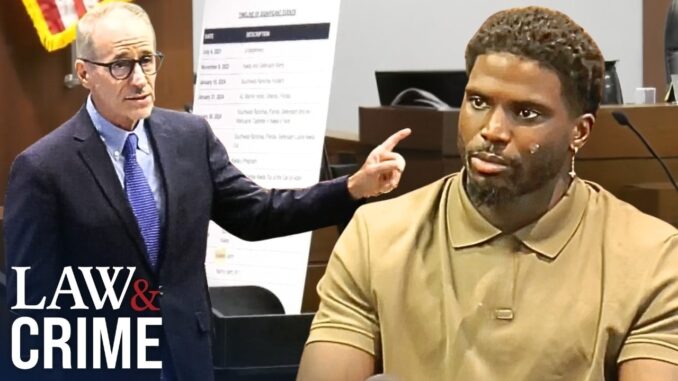

Original courtroom coverage: Law&Crime Trials. This article draws on the channel’s recording of the plaintiff’s closing argument in Lakeeta Vaccaro Hill’s civil assault-and-battery and divorce case against Tyreek Hill in Miami-Dade County.
Lakeeta Vaccaro Hill’s attorney asked jurors to find the NFL player liable and award $8 million in compensatory damages, arguing that recordings, text messages, witness testimony and Hill’s own statements supported her allegations of physical and emotional abuse during their approximately 18-month marriage.
Tyreek Hill denies physically abusing her. He has admitted to verbal abuse and threatening language. He faces no criminal charges and was never arrested over these allegations.
Closing arguments are attorney arguments, not evidence, and the jury has not yet reached a verdict at the stage covered here. The recording contains the plaintiff’s closing presentation and ends as counsel turns the floor over to the defense. Defense positions discussed below are those addressed within that presentation, not a separate defense closing argument.
The Civil Standard and the Jury’s Role
The plaintiff’s attorney opened by thanking jurors for their punctuality and attention, then emphasized the distinction between the judge’s role in explaining the law and the jury’s role in deciding disputed facts.
He framed the central question as one of credibility: whether jurors should accept Vaccaro Hill’s accounts of alleged abuse or Hill’s denials. His argument was that her accounts had remained consistent while Hill’s explanations had changed.
Counsel also stressed that this was a civil case, not a criminal prosecution. The liability standard he described was the greater weight of the evidence, rather than proof beyond a reasonable doubt. Using a scale analogy, he told jurors that the evidence needed to tip in the plaintiff’s favor. He acknowledged that if the evidence instead supported Hill, the verdict should favor him.
That distinction is important to the discussion of police responses. The absence of an arrest does not itself resolve a civil claim, but neither does a civil allegation establish criminal wrongdoing. For general context, Cornell Law School explains the preponderance-of-the-evidence standard commonly used in civil litigation.
The April 7 Recording and the Emotional-Distress Claim
The plaintiff’s attorney made an April 7 confrontation a central part of his closing. He referred jurors to a nanny-camera recording identified as plaintiff’s Exhibit 14 and an edited 911 call identified as Exhibit 15.
He recalled testimony in which Hill acknowledged that, during the recorded exchange, he was trying to hurt his wife emotionally. Counsel argued that this acknowledgment supported her claim for intentional infliction of emotional distress.
As counsel described the claim, jurors needed to consider intentional conduct beyond the bounds of decency, intended to cause emotional distress and resulting in severe emotional distress. An acknowledgment of hurtful intent is not, by itself, a jury finding that every legal element has been satisfied.
The attorney characterized the recording as showing Hill pushing Vaccaro Hill’s mother to the ground. He described her mother as a 63-year-old woman weighing approximately 105 pounds and argued that she got back up to protect her granddaughter. He also alleged that Hill restrained Vaccaro Hill against a wall while she tried to keep him away from their baby.
According to counsel’s account, Vaccaro Hill told her mother to call 911. He described the call as capturing her mother’s distressed voice and Vaccaro Hill screaming in the background. He urged jurors to assess the admitted recordings themselves rather than rely solely on either party’s account.
The Dispute Over Hill’s Earlier Statements
Counsel contrasted that material with Hill’s deposition testimony from July 23, in which, according to the closing argument, Hill denied having physical contact with anyone on April 7. The attorney argued that Hill made that denial before learning that a recording existed.
He also referred to a responding Sunny Isles officer’s testimony, saying the officer observed bruising on Vaccaro Hill’s chest, a plate of eggs on the floor and a computer on the ground. Counsel argued that those observations supported her account. He challenged a police-report description of conduct as lacking malice, characterizing it as the officer’s conclusion rather than Vaccaro Hill’s words.
The attorney acknowledged Hill’s expressions of regret. He recounted Hill describing himself as having reached a breaking point, acting in the heat of the moment and feeling ashamed. Counsel urged jurors to distinguish an apology from the separate question of civil liability.
Alleged Contradictions About Physical Contact
Another major theme was the plaintiff’s contention that Hill’s testimony contained incompatible accounts of physical contact.
Counsel recalled Hill initially denying that he had put his hands on his wife, shoved her, restrained her or allowed arguments to become physical. He then played testimony that counsel interpreted as an acknowledgment that Hill pushed her against a wall and created a hole.
The attorney disputed Hill’s explanation about when that encounter occurred. He also questioned the plausibility of Hill’s account that the couple became intimate afterward.
Hill’s clarification was also part of the presentation. Counsel played a later clip in which Hill said he had misspoken and meant that he was trying to evade his wife. The plaintiff’s attorney argued that the clarification was an attempt to retreat from an earlier admission. That characterization remained an advocacy argument for the jury to evaluate, not a finding that Hill had admitted physical abuse.
The Postnuptial Agreement Dispute
The plaintiff’s attorney linked several alleged incidents to disagreements over a proposed postnuptial agreement.
He directed jurors to a January 26 email forwarding an agreement for Vaccaro Hill to sign. He expressly acknowledged that jurors did not have the agreement itself. He nevertheless argued, based on the trial presentation, that the proposal would limit recovery for emotional harm caused by Hill to $1.
Counsel asked jurors to consider why such a provision would have been proposed and argued that Vaccaro Hill wanted to discuss it rather than simply sign. These were proposed inferences about the parties’ motives, not established conclusions about what either party intended.
The Eight Incidents Addressed in the Closing
Alongside April 7, the attorney reviewed seven other dates underlying the plaintiff’s allegations. He repeatedly asked jurors to compare her testimony with messages sent near the time of the alleged events, police testimony and Hill’s explanations.
January 10: Alleged Necklace and Ring Confrontation
For an alleged incident at the Southwest Ranches home, counsel recounted Vaccaro Hill’s testimony that Hill became angry about the postnuptial agreement, tried to remove her ring, pushed her onto a bed, placed his hands around her neck and pulled off her necklace.
He pointed to a photograph of a cut and a message to her mother describing an alleged struggle over the necklace, an effort to remove her from the home and clothes being thrown.
Hill denied touching her. Counsel also addressed Hill’s explanation that he lacked fingernails capable of causing the cut, arguing that the photograph and contemporaneous message supported her account. The origin of the cut and responsibility for it remained disputed.
January 21: Alleged Assault at an Orlando Hotel
Counsel next discussed an alleged confrontation at the AC Marriott hotel in Orlando. He recounted Vaccaro Hill’s testimony that, after a disagreement associated with the postnuptial agreement, Hill threw her computer, tried to take her wedding ring by force and twisted her breast.
The attorney identified the computer as plaintiff’s Exhibit 9 and a text exchange as Exhibit 11. He contrasted Hill’s testimony that there had been no communications about an injury with messages in which Vaccaro Hill complained about alleged contact with her breasts.
According to counsel’s description, Hill apologized in the exchange and referred to his behavior during intercourse. Vaccaro Hill responded that the alleged conduct did not occur during sex. Counsel argued that the exchange supported her testimony, while Hill continued to deny physically abusing her.
The lack of visible injuries was a significant defense point. Counsel acknowledged that an Orlando officer did not observe an apparent injury and that later photographs showed no redness. He also addressed observations that Vaccaro Hill was not disheveled and that the hotel room did not contain scattered luggage.
The plaintiff’s response was that time had passed before the officer arrived, Vaccaro Hill had changed and prepared to leave, and the photographs were taken later still. Counsel cited medical testimony that the alleged breast twisting would not necessarily leave visible marks after that interval.
He further argued that, under the civil battery instructions, physical injury was not required to establish intentional contact offensive to an ordinary person. That legal argument did not remove the plaintiff’s obligation to prove that the disputed contact occurred.
January 30: Alleged Contact With a Blunt and Removal From the Home
Vaccaro Hill allegedly testified that Hill pushed an unlit blunt into her face, carried her out of the Southwest Ranches home, put her luggage outside and locked her out. Counsel referred to a locksmith video as support for her account of needing help to reenter.
Hill’s account differed. As recounted in the closing, he said he flicked the blunt toward her rather than shoved it into her face, and he denied wrongdoing. Counsel also addressed a defense dispute over whether ashes entered her eye.
The attorney described a subsequent phone call involving Vaccaro Hill, her mother and her brother. He said her family heard her scream before the line disconnected, prompting her mother to call police.
Counsel emphasized a limitation in Vaccaro Hill’s own account: she testified that Hill did not put his hands on her when he returned to the house during that later portion of the encounter. He argued that this distinction supported her credibility because she did not allege additional physical contact at every opportunity.
He also cited testimony about an apology to her mother and messages in which Hill expressed regret and offered to attend therapy. Counsel treated those apologies as corroboration; their meaning and scope remained matters for the jury.
May 1: Disputed Departure From a Car
The attorney recounted Vaccaro Hill’s allegation that, while returning from a Netflix “W.A.G.s to Riches” event, Hill became angry after she commented on his behavior when drinking. She alleged that he threw a shoe out of the car and pushed her against the door to make her leave.
Counsel referred to a Lyft receipt admitted into evidence. He contrasted her account with Hill’s explanation that the couple had an argument and she wanted to get out of the car. Counsel questioned that explanation given the late hour, the Miami Beach location and her pregnancy.
The receipt was offered as support for the surrounding circumstances. It did not independently establish the alleged physical contact.
May 15: Threatening Language in a Car
For May 15, counsel described Vaccaro Hill’s testimony that Hill ordered her out of a car during another disagreement over the postnuptial agreement. According to her account and her mother’s testimony, Hill threatened to hurt her if she did not leave and said others could hurt her.
The closing also addressed Hill’s acknowledgment that he made statements about being able to get people to hurt her. Counsel recounted Hill expressing shame, describing the remarks as made in the heat of the moment and saying he wished he could take them back.
The plaintiff’s attorney argued that those statements satisfied the civil assault requirements described in the judge’s instructions, including an intentional threat of violence and an apparent ability to carry it out imminently. Hill’s admission to threatening language did not amount to a jury determination of civil assault liability.
July 12, 2024: Allegations in Bristol, Connecticut
Counsel discussed Vaccaro Hill’s testimony about an alleged incident in a Bristol hotel room on July 12, 2024. She alleged that Hill pulled her by the hair and punched toward her stomach while she tried to protect herself and her unborn child.
The attorney acknowledged that there were no cameras or third-party witnesses in the room. He asked jurors to assess her credibility directly.
As counsel recounted it, Hill initially said he did not remember an argument, then acknowledged a disagreement about financial arrangements after further questioning. The plaintiff’s attorney argued that Hill’s requests to have his recollection refreshed undermined his reliability. That was counsel’s interpretation of the testimony, not an independent determination of dishonesty.
November 24: Alleged Spitting During a Bedroom Argument
The attorney described a disputed argument at the Sunny Isles condominium shortly before Vaccaro Hill gave birth. He said the parties gave different explanations for the disagreement over her clothing and argued that testimony supported her allegation that Hill spat in her face.
Counsel also referred to her sister’s testimony about another alleged spitting incident and her mother’s account of family members entering the bedroom during the November dispute.
When the plaintiff’s attorney asked why the defense had not called Hill’s relatives, defense counsel objected that the argument improperly shifted the burden of proof. The judge reminded jurors to follow the burden-of-proof instructions. The defense had no obligation to call those witnesses.
The Defense Challenges Addressed by Plaintiff’s Counsel
The closing responded to several defense themes beyond Hill’s denials of physical abuse:
- Police observations and no arrest: Counsel acknowledged the absence of visible injuries during the Orlando response and that police did not pursue the allegations. Hill was never arrested over these allegations and faces no criminal charges.
- Divorce timing and financial motive: The defense challenged whether the allegations and discussions of her “best option” were connected to divorce strategy or money. Plaintiff’s counsel argued that earlier messages and her decision to pursue marriage counseling contradicted that theory.
- Affectionate messages: The defense relied on loving or conciliatory communications. Counsel cited testimony from Vaccaro Hill’s counselor about appeasement and fear as possible responses in abusive relationships.
- Nondisclosure in treatment: The defense pointed to occasions when Vaccaro Hill did not report abuse to providers, including a form on which she denied abuse. Counsel argued that nondisclosure did not necessarily mean the alleged conduct had not occurred.
- Surveillance footage: The defense used footage to question whether she feared Hill. Counsel responded that she participated in parenting-related meetings for her daughter and insisted on public settings.
- Psychological diagnosis: A defense expert disputed the plaintiff’s PTSD position. Counsel challenged the expert’s preparation and contrasted that opinion with the plaintiff’s psychological evaluation.
These disputes concerned the significance of the evidence as well as whether the alleged events occurred. Affectionate communications, counseling choices and public interactions could be interpreted differently by the opposing parties; none independently resolved the allegations.
Disclosure, Counseling and Alleged Coercive Control
The plaintiff’s attorney cited testimony from therapists and psychologists that people may conceal intimate-partner violence because of fear, possible retaliation, a desire to preserve a marriage or coercive control.
He argued that those explanations applied to Vaccaro Hill. He characterized Hill’s handling of family finances, accusations about spending, expectations about her availability at home and a condominium sale listing made without telling her as examples of alleged control.
Counsel also suggested that joint counseling by Zoom could have made candid disclosure difficult if Vaccaro Hill feared what might happen after a session ended. These were arguments about her circumstances, not findings that Hill exercised coercive control or that nondisclosure proved abuse.
He contrasted the defense’s financial-motive theory with messages in which Vaccaro Hill discussed commitment, faith and preserving their marriage. His position was that she was trying to sustain the relationship rather than prepare litigation.
Broader Credibility Arguments
Counsel challenged Hill’s credibility on subjects beyond the alleged confrontations. He contrasted Hill’s account of attending prenatal and postpartum appointments with a medical witness’s testimony that Hill was present for the delivery but not those visits.
He also discussed a disputed hospital selfie, Hill’s acknowledgment that he gave Vaccaro Hill an inaccurate explanation about a planned outing with their child, and testimony about housing arrangements for Hill’s mother.
The attorney’s argument was that inconsistencies on those subjects should affect jurors’ assessment of Hill’s accounts of more consequential events. Those collateral disputes did not themselves establish the alleged assaults or batteries.
Counsel similarly challenged Hill’s account that he routinely walked away to deescalate arguments. He contrasted it with Vaccaro Hill’s allegations that Hill instead forced or threatened her to leave homes and vehicles. Hill’s explanation and the plaintiff’s competing account remained for jurors to assess.
The $8 Million Damages Request
The closing ended with the plaintiff’s request for compensation for alleged emotional distress, mental anguish, pain and suffering.
Counsel cited a psychologist’s testimony that Vaccaro Hill experienced PTSD, anxiety and depression. He argued that the alleged harm was substantial despite the absence of lasting visible scars. He also acknowledged other difficult circumstances in her life, including losing her father when she was young and undergoing a high-profile divorce.
The defense expert disputed the PTSD position. The plaintiff’s attorney criticized that expert’s compensation and asserted that the opinion was formed without reviewing important records and recordings. Defense counsel objected to his characterization of the expert as selling an opinion; the judge overruled the objection. That ruling was not a finding that either expert’s diagnosis was correct.
Counsel proposed two ways to assess damages:
- A daily calculation: Using January 10 as an example, he suggested $500 a day for the 651 days he said had elapsed, then a further period for future harm. He left the daily amount and duration to the jury’s judgment.
- An overall award: He suggested $8 million across eight alleged incidents, describing it as $1 million for each incident.
These were proposed damages figures, not an award. Counsel also asked jurors to find clear and convincing evidence of intentional misconduct for the punitive-damages issue and argued that the April 7 recording supported that finding. He urged them to consider alleged harm to Vaccaro Hill’s mother under the instructions discussed in court.
No Verdict at This Stage
In his final appeal, the plaintiff’s attorney urged jurors to put Hill’s celebrity and football achievements aside, determine liability on each count and award damages they considered fair. He then turned the presentation over to the defense.
The recording therefore documents an advocate’s request for a verdict, not a resolved case. The jury has not yet reached a verdict at this stage. Hill denies physically abusing Vaccaro Hill, while acknowledging verbal abuse and threatening language, and he faces no criminal charges arising from these allegations.
Full credit for the original courtroom recording belongs to Law&Crime Trials. The channel’s recording of the plaintiff’s closing argument is embedded below.



Be the first to comment